


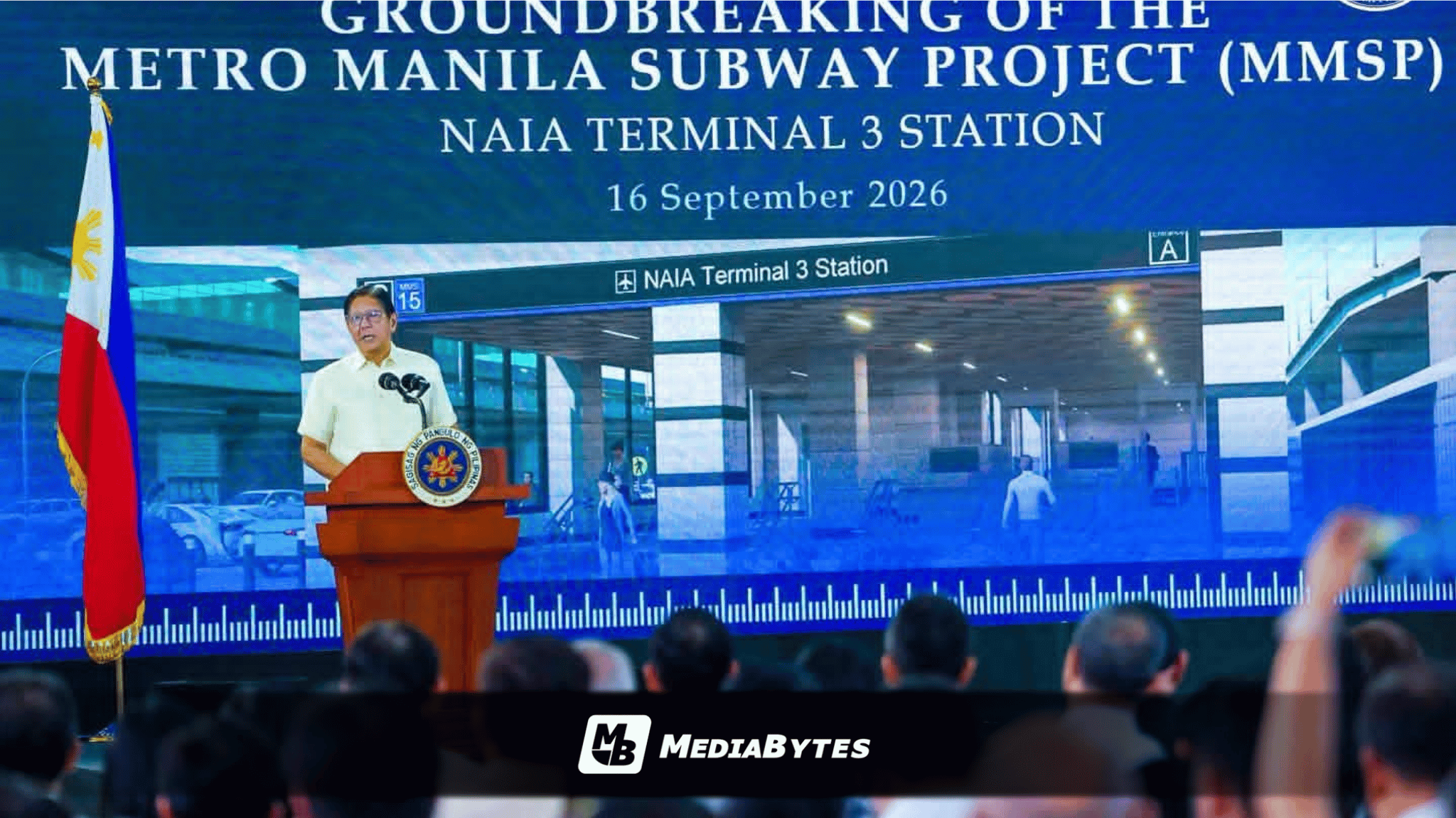
President Ferdinand Marcos Jr. has called on contractors, engineers, and workers to ensure the Metro Manila Subway Project (MMSP) is completed safely, efficiently, and according to schedule.
Marcos made the appeal on Wednesday, September 16, during the groundbreaking ceremony for Contract Package 109 (CP109) held at Ninoy Aquino International Airport (NAIA) Terminal 3 in Pasay City.


In his speech, the President emphasized the important role of workers and contractors in delivering major infrastructure projects.
“[T]o our contractors, our engineers, and workers: much of what we celebrate in projects like this rests on the work that you do every day. I ask that you carry out this project safely, efficiently, and on time, with the quality that generations of Filipinos deserve,” Marcos said.
“As we break ground on Contract Package 109, let us continue this work with urgency, discipline, and with excellence,” he added.
Marcos said the overall construction progress of the Metro Manila Subway has reached nearly 60 percent.
The subway is being designed to accommodate 30 eight-car trainsets, with trains capable of reaching speeds of up to 80 kilometers per hour. Full completion of the system is targeted for the third quarter of 2031.
Once operational, the railway is expected to cut travel time between Valenzuela and NAIA from around 90 minutes to approximately 40 minutes.


The President previously led the groundbreaking for the subway’s Kalayaan Avenue and Bonifacio Global City stations in February.
“From Quezon City to Taguig and now toward our international airport, the Metro Manila Subway is steadily taking shape. And that progress matters because moving around Metro Manila still takes far too much time,” Marcos said.
CP109 will cover the construction of the underground NAIA Terminal 3 Station and connecting tunnels linking portions of Taguig and Pasay.
According to Marcos, the station will give passengers direct rail access to the country’s busiest airport terminals, further connecting the subway system to the international gateway.
The President also thanked Japan and the Japan International Cooperation Agency (JICA) for their continued assistance in developing the subway project.
Marcos acknowledged the technical challenges involved in constructing a railway beneath a densely developed urban area.
“Of course, building a subway beneath a dense and highly developed city is no simple undertaking,” Marcos said.
He said CP109 will introduce advanced engineering techniques to the Philippines, including the underpinning of existing expressway piers to allow tunnels to pass beneath them.
“That is why CP109 will also introduce advanced engineering methods to the Philippines. Its tunnels will require the underpinning of existing expressway piers, the first application of this type of technology for tunnel construction in the country,” Marcos added.
“Proven in Japan, this method will help ensure that construction can proceed safely beneath existing infrastructure while also maintaining structural integrity,” he further said.
Marcos said the subway is part of the government’s broader push to improve transportation and connectivity in Metro Manila and beyond.
He cited other ongoing railway initiatives, including the North-South Commuter Railway, MRT-7 and the Common Station, as part of efforts to expand the country’s rail network and improve mobility.