


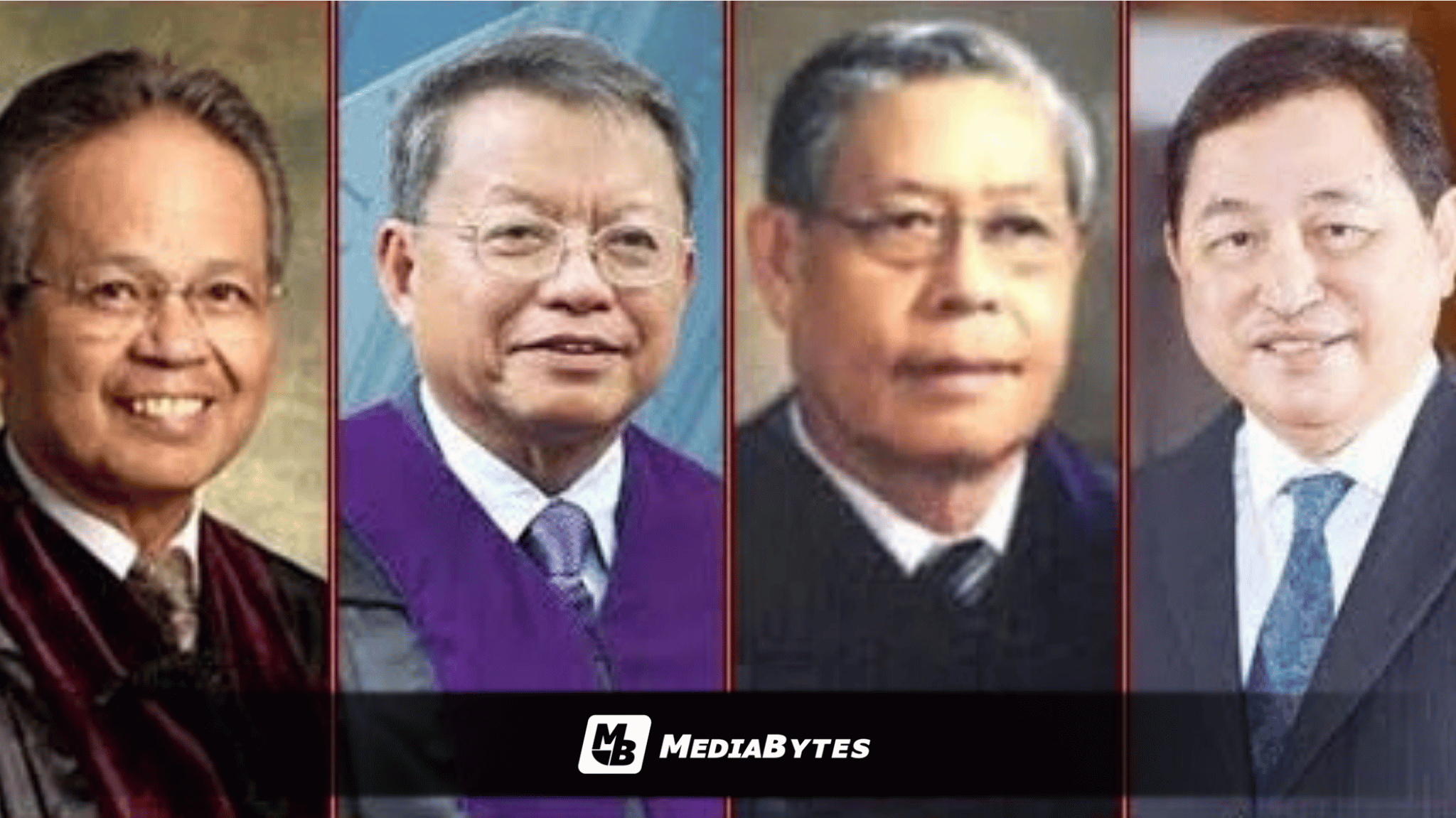
Four retired Supreme Court justices on Wednesday, September 16, gave the Senate impeachment court their legal views on a key question in Vice President Sara Duterte’s impeachment trial: how the constitutionally required two-thirds vote for conviction should be calculated.
Retired Chief Justices Artemio Panganiban and Reynato Puno, as well as retired Associate Justice Adolfo Azcuna, personally appeared before the Senate impeachment court on the 26th day of the proceedings. Retired Chief Justice Hilario Davide Jr. submitted his position through a written memorandum, which was read into the record.
The four were invited as amici curiae, or “friends of the court,” after questions arose over the Senate’s earlier determination that 16 votes, equivalent to two-thirds of the chamber’s 24 members, are needed to convict Duterte.
The issue became particularly significant because some senator-judges have been absent from portions of the proceedings due to detention, legal restrictions, being abroad or other circumstances.
The court asked the retired justices to address whether “all the Members of the Senate” under Article XI, Section 3 of the 1987 Constitution should always refer to all 24 senators or whether the voting base may change depending on which members are legally qualified and able to participate.
Davide: Qualified senators should form the basis
In his memorandum, Davide argued that the two-thirds requirement should be based on senators who are legally qualified to vote rather than automatically applying it to all 24 members of the Senate.
He said senators who are detained, abroad, suspended, incapacitated or otherwise prevented from performing their official functions may be excluded from the computation under certain circumstances.
“Clearly then, the basis of computing the two-thirds must be the number of senators who are qualified to vote, not the 24 in the present Senate,” Davide said.
Davide also maintained that senators unable to participate because of legal or physical restrictions should not necessarily be included in the voting denominator.
Panganiban questions a fixed 16-vote requirement
Panganiban similarly argued that the 16-vote threshold should not automatically be considered an unchanging figure.
He said constitutional interpretation should take into account the circumstances surrounding the senator-judges who are actually capable of performing their duties in the impeachment proceedings.
“Active participation and independent evaluation of the evidence are essential to discharge the Senate’s and the Senator’s constitutional responsibility,” Panganiban said.
He also emphasized the importance of senator-judges personally participating in the proceedings and evaluating the evidence before casting a vote.
Panganiban said the Constitution should be interpreted in a practical manner when determining how the two-thirds requirement applies to the impeachment proceedings.
Puno also supports a contextual approach
Puno likewise said the number of votes required for conviction could change depending on circumstances affecting which senators should legally be counted.
He noted that the Constitution specifies a fraction—two-thirds of all members—rather than expressly stating that exactly 16 votes are always required.
“By using two-thirds, the number of votes to convict will have to move depending on certain factors,” Puno said.
Puno also said a strictly literal interpretation of the provision could produce circumstances inconsistent with the purpose of the constitutional requirement.
Both Puno and Panganiban stressed that the Senate impeachment court itself has the constitutional authority to try and decide impeachment cases.
“That is why I explained the Senate impeachment court is not under the Supreme Court. If the Constitution wanted the Supreme Court to decide on impeachment cases, then the Senate impeachment court should have been listed under Article VIII of the Constitution on the Judiciary, not Article XI, which is Accountability of Public Officers,” Puno said.
Panganiban likewise said the Senate impeachment court is an independent tribunal tasked by the Constitution with deciding impeachment cases.
Azcuna takes a different position
Azcuna presented a different interpretation from the other three retired justices, maintaining that all sitting senators should remain part of the denominator when determining the two-thirds requirement.
“As long as he is a member of the Senate he has to be included in the two-thirds denominator. The only exception is if he dies, if he is removed from office or if he resigns. No more,” Azcuna said.
Under Azcuna’s interpretation, the voting base should not fluctuate based on whether a senator is absent, detained or unable to participate in particular portions of the trial.
He also said the Senate could establish internal rules regarding whether a senator who did not attend or substantially participate in the proceedings could still cast a final vote, separate from the question of who should be included in the two-thirds denominator.
The retired justices also discussed the relevance of the Supreme Court’s 1949 ruling in Avelino v. Cuenco. Their views differed on whether the case, which dealt with Senate quorum issues, could provide guidance in determining the voting threshold for an impeachment conviction.
The amici curiae further addressed whether senator-judges who were absent from hearings or did not substantially participate could still vote on the final judgment. Their interpretations differed on how participation should affect a senator’s ability to cast a vote.
The House prosecution panel did not challenge the retired justices’ participation. Lead prosecutor Batangas 2nd District Representative Gerville “Jinky Bitrics” Luistro instead thanked the former magistrates for providing their legal perspectives to the impeachment court.
The prosecution and Duterte’s defense team are scheduled to present their respective arguments on the disputed voting threshold on September 23. The Senate impeachment court will then consider the issue before proceeding toward a final judgment in the case.