


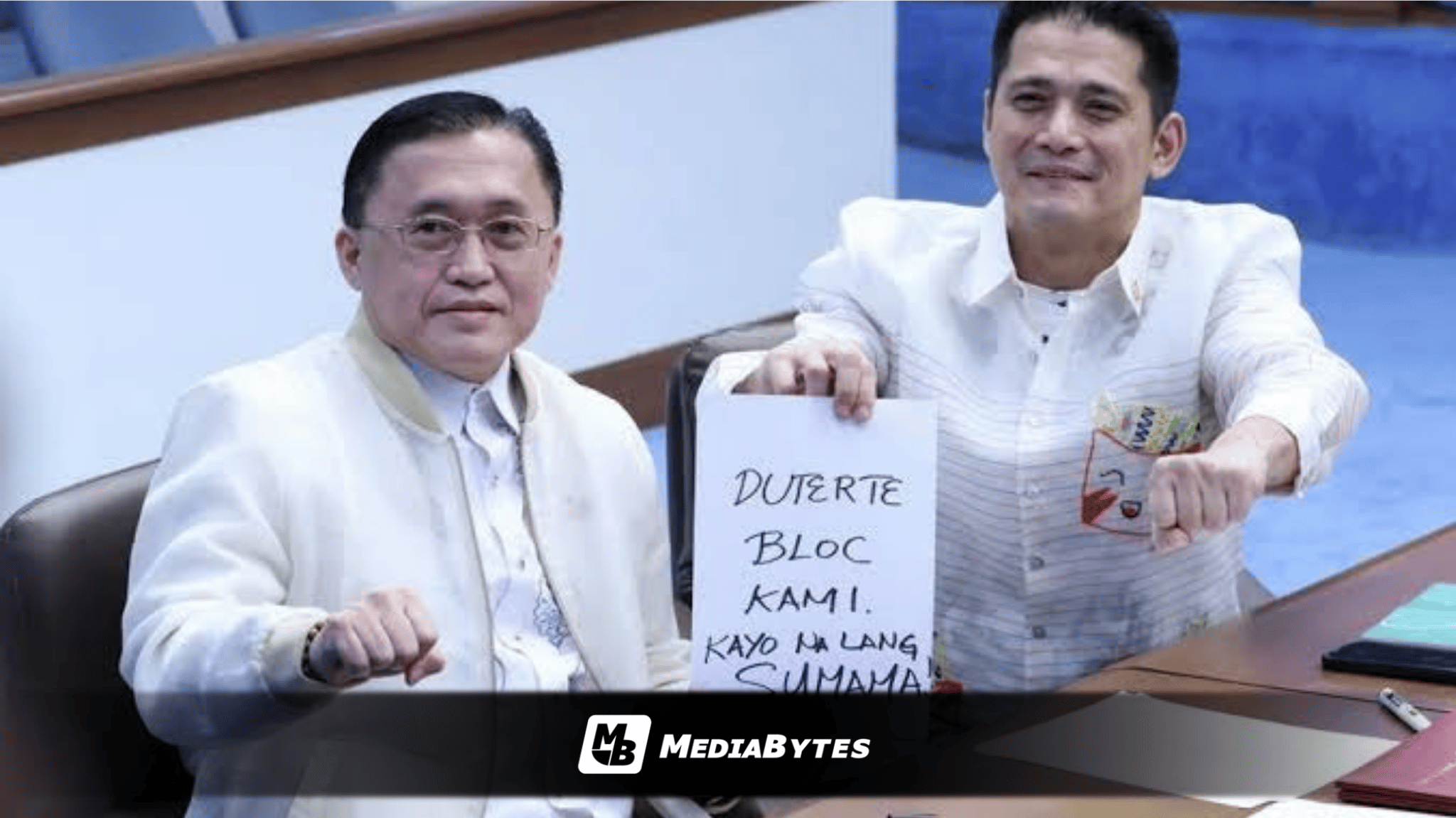
MANILA, Philippines — Senators Robin Padilla and Christopher “Bong” Go, together with several co-petitioners, have turned to the Supreme Court to challenge the constitutionality of a September 23 Senate Impeachment Tribunal ruling that revised the vote requirement needed to convict an impeached official.
To prevent the enforcement of the controversial September 23 measure while the case is being evaluated, the petitioners are asking the High Court to issue a status quo ante order (SQAO) or a temporary restraining order (TRO).
In their submission, Padilla, Go, and their fellow petitioners asserted that the Constitution mandates a baseline of at least 16 out of 24 votes from senators to secure a conviction. They stressed that “no senator who holds office may be excluded from the count by reason of detention, suspension, incapacity, absence, nonparticipation, or any similar circumstance.”
The group also petitioned the tribunal to render any future judgment against Vice President Sara Duterte null and void if the Senate delivers a conviction based on the altered September 23 baseline before the court resolves the matter, maintaining that any decision issued under that framework should be treated as “without force or effect.”
This latest legal attempt follows a September 30 ruling in which the Supreme Court tossed out three previous petitions questioning the Senate’s September 23 action.
Those initial cases were thrown out “on procedural grounds including lack of standing and prematurity,” though the formal September 30 resolution has yet to be officially released.
Former Executive Secretary Vic Rodriguez, Berteni Cataluna Causing, and Atty. Ernesto Francisco Jr. lodged the earlier filings, which similarly sought to restore the two-thirds threshold calculated against the full 24-member chamber as prescribed by basic law.
In this current filing, the petitioners argued that the Senate lacks the authority to decide which sitting members are factored into calculating the final vote requirement.
“The Constitution does not count only the Senators it finds convenient. It says ‘all,’ and ‘all’ has never meant ‘some.’ Two-thirds of twenty-four is sixteen. It was sixteen when the Senate convicted a Chief Justice, and it was sixteen on the first day of this trial. It cannot become fourteen because a majority, in the middle of the proceedings and for this case alone, has decided which of its own members deserve to be counted.”
Highlighting the gravity of stripping a nationally elected leader of office, the filing characterized the removal mechanism as an extraordinary power that countermands the public will.
“The power to remove a nationally elected official “is the gravest power a legislature holds, because it undoes the choice of the sovereign people.”
According to the petition, the framers intentionally fixed the voting fraction to safeguard against simple majorities lowering the hurdle on a whim.
The petition argued that the Constitution “fenced it in with a number no majority may lower.”
While acknowledging that the Senate holds full constitutional authority to conduct impeachment trials, the petitioners maintained that such proceedings must remain strictly within the specific voting parameters enshrined in the Constitution.
“The Senate may try. The Senate may decide. It may not convict with fewer votes than the Constitution requires. Impeachment answers to the Constitution, not to the preferences of those who wield it. If the arithmetic of conviction can be changed whenever the votes fall short, the threshold stops being a safeguard and becomes a target.”
The group clarified that their legal action is not intended to steer or dictate the outcome of the ongoing trial itself.
They explained that the petition “does not ask the Court to acquit or to convict.”
Instead, they stated that they are appealing to the Supreme Court “the Court to count, and in counting, to remind every branch of government that the Constitution is not suspended when it becomes inconvenient.”
Furthermore, they warned that altering fundamental ground rules mid-trial threatens the integrity of the constitutional system as a whole.
“When the rules are rewritten so the outcome can come out differently, the verdict is not the only thing on trial, the Republic is.”
Joining Padilla and Go in the petition are the Partido Demokratiko Pilipino-Lakas ng Bayan (PDP-LABAN), represented by party chairperson and former Energy Secretary Alfonso Cusi; Atty. Esraelito Torreon; Atty. Jimmy Bondoc; Atty. Ferdinand Topacio; Atty. Raul Lambino; Resci Angelli R. Rizada-Nolasco; and Philip Salvador.
Named as respondents are the Senate of the Philippines, sitting as the Impeachment Court and represented by Senate President Win Gatchalian; Senator Francis “Chiz” Escudero, the presiding officer of the Senate Impeachment Court; the House of Representatives, led by Speaker Faustino “Bojie” Dy III; and the prosecution panel headed by Batangas 2nd District Representative Gerville Luistro.
At the core of the constitutional debate is Article XI, Section 3(6) of the 1987 Constitution, which provides:
“The Senate shall have the sole power to try and decide all cases of impeachment. When sitting for that purpose, the Senators shall be on oath or affirmation. When the President of the Philippines is on trial, the Chief Justice of the Supreme Court shall preside, but shall not vote. No person shall be convicted without the concurrence of two-thirds of all the Members of the Senate.”