


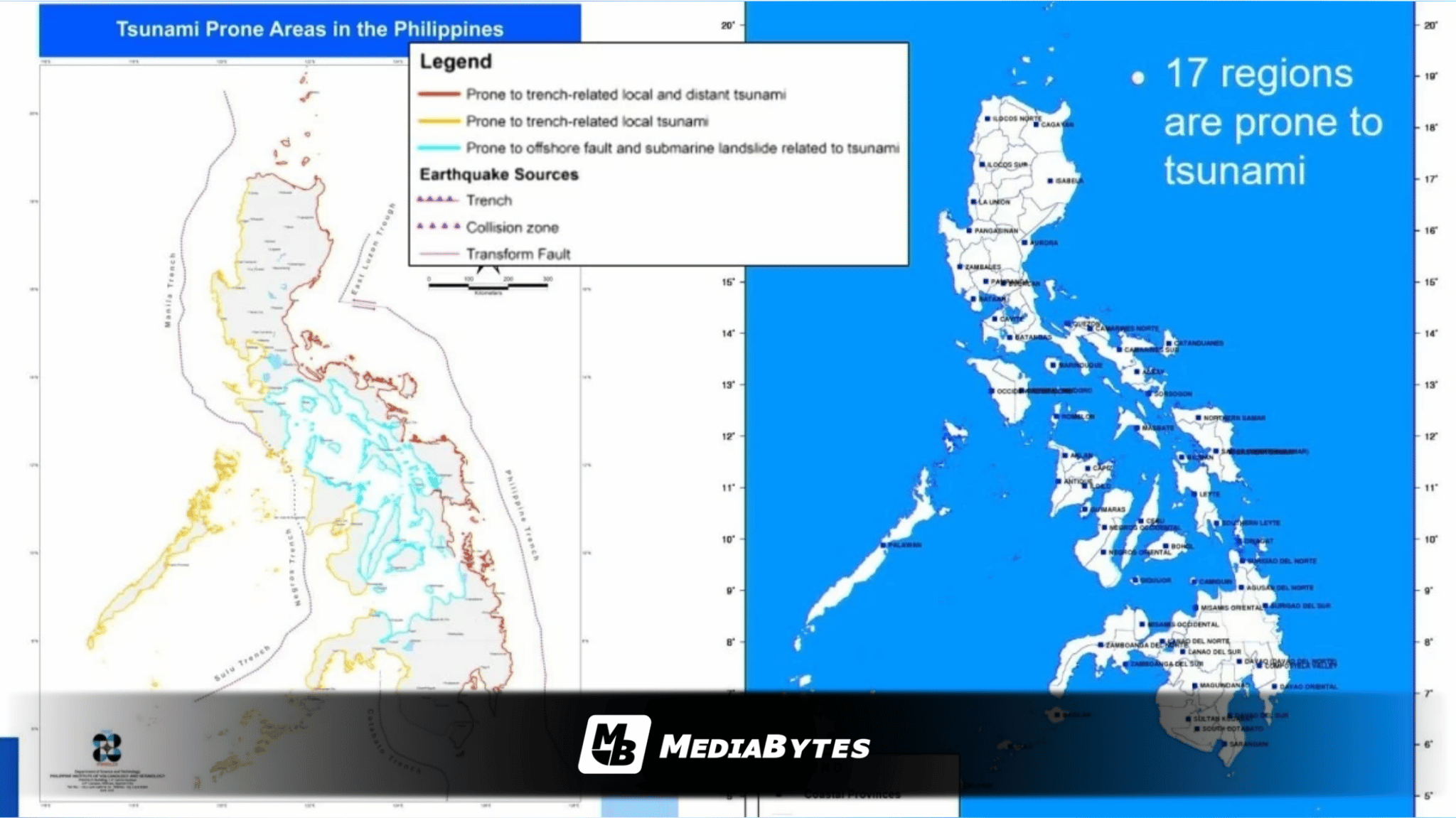
QUEZON CITY — Ahead of World Tsunami Awareness Day on November 5, the Philippine Institute of Volcanology and Seismology (PHIVOLCS) has underscored the critical need for disaster preparedness, revealing that a vast majority of the country’s provinces face tsunami risks.
During a press conference on Tuesday, October 13, PHIVOLCS Deputy Director Dr. Mylene Villegas emphasized the country’s high exposure to seismic hazards driven by surrounding trenches and active faults.
She pointed out that coastal communities across 66 out of the nation’s 82 provinces are vulnerable to tsunami threats.
“Sa 82 po natin na probinsya, 66 po dyan ang may coastal communities. And so lahat po ng iyan dahil po sa tayo ay nalilibutan ng dalawang trench at mga fault, ay prone sa tsunami,” Villegas said.
In addition to provincial coastal areas, PHIVOLCS identified eight cities in Metro Manila—Valenzuela, Navotas, Malabon, Manila, Pasay, Las Piñas, Parañaque, and Caloocan—that face potential exposure to tsunamis generated by movements along the Manila Trench.
“Yan po ang focus natin pagdating sa paghanda para sa tsunami…kasama po ang Metro Manila dahil po sa posibilidad na magkaroon ng paglindol na magge-generate ng tsunami kung ito ay manggagaling sa Manila Trench,” she explained.
The Philippines is historically prone to these seismic hazards due to major offshore fault systems, including the Philippine, Manila, and Cotabato trenches.
Historical data from the agency shows that 41 confirmed tsunami events struck the country and surrounding waters between 1589 and 2012, notably including the devastating 1976 Moro Gulf and 1994 Mindoro tsunamis.
“Sa history po natin sa Pilipinas, marami po na rin mga large magnitude earthquakes na naganap, na nag-resulta sa tsunami,” Villegas noted, urging local communities to stay vigilant and recognize natural warning signs.