


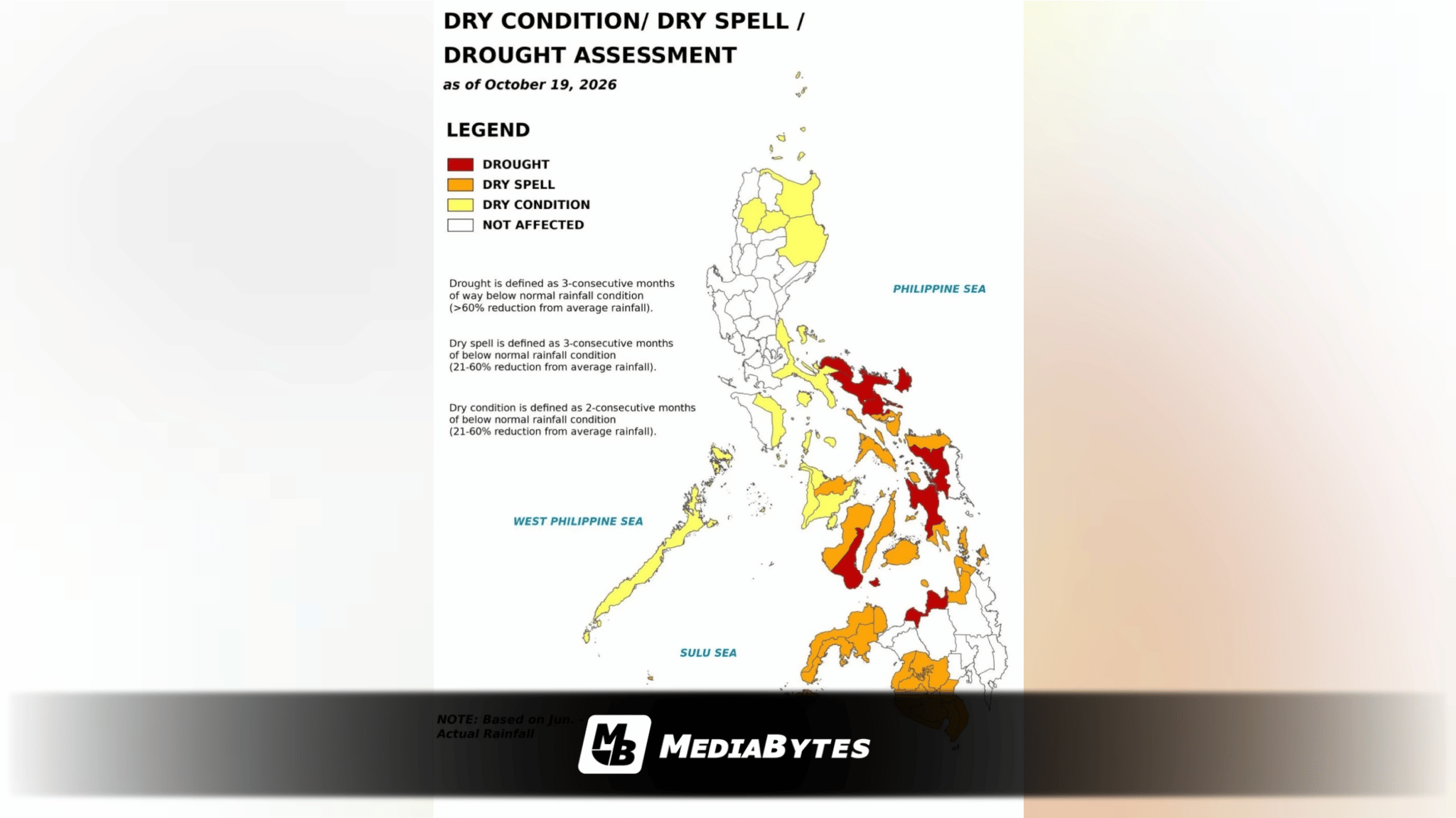
MANILA, Philippines — Over 50 areas across the Philippines experienced drier-than-usual weather from October 1 to 18 as a strong to very strong El Niño continues to impact the tropical Pacific, state weather bureau PAGASA reported.
PAGASA weather specialist Joanne Mae Adelino noted that while central Mindanao recorded near-normal rainfall, the rest of the country mostly saw below-normal to way-below-normal precipitation.
“Malaking bahagi po ng ating bansa ang nakatanggap na po ng way below to below normal rainfall conditions,” Adelino stated during PAGASA’s climate forum.
As of October 19, government data showed that 14 areas are experiencing dry conditions, 30 are under a dry spell, and nine are facing drought. PAGASA defines dry conditions as two consecutive months of a 21% to 60% reduction in average rainfall. A dry spell involves three consecutive months with the same reduction level, while a drought indicates three consecutive months of way-below-normal rainfall with more than a 60% reduction.
According to PAGASA’s climate outlook, the prevailing El Niño is projected to peak before the end of 2026 and persist through the first quarter of 2027, with impacts potentially lasting into the year’s first half.
PAGASA-Climate and Agrometeorology Division assistant weather services chief Ana Liza Solis explained that unusual wind patterns are currently suppressing rainfall-producing convective activities.
“So usually po, typical kapag po walang El Niño at during papasok ang amihan or northern hemisphere winter, ang ating hangin ay easterlies,” Solis said.
“Pero ngayon, so nakikita po natin dito sa baba yung hangin natin ay mas stronger yung westerlies. So pabaligtad po ang hangin, so yan po ang nagtataboy palayo ng ating mga convective activity, kaya po nagkakaroon ng mga suppressed convection dahil pa westerlies po at nakikita po natin diyan napakalakas po ng westerly wind flow diyan po sa Central at Eastern Equatorial Pacific. Palayo sa atin yung mga convective activity na magbibigay ng mga posibleng pag-ulan,” she added.
Despite these conditions, rain-bearing systems such as the northeast monsoon and the intertropical convergence zone may still bring precipitation to parts of the nation. However, rainfall is projected to decrease further by January 2027, gradually leading to widespread meteorological drought.
PAGASA projects that the entire country could experience drought conditions by March and April 2027.
Although neutral climate conditions are expected by the April-May-June 2027 period, Solis warned that the consequences of the prolonged El Niño will linger.
“So hindi po ito nangangahulugan na hanggang March-April-May lang din yung possible na impact dito sa atin. So lagi po meron siyang lag effect, at least two to thre months po yung impact, lalong-lalo na po kapag galing tayo sa prolonged El Niño episode,” Solis concluded.