


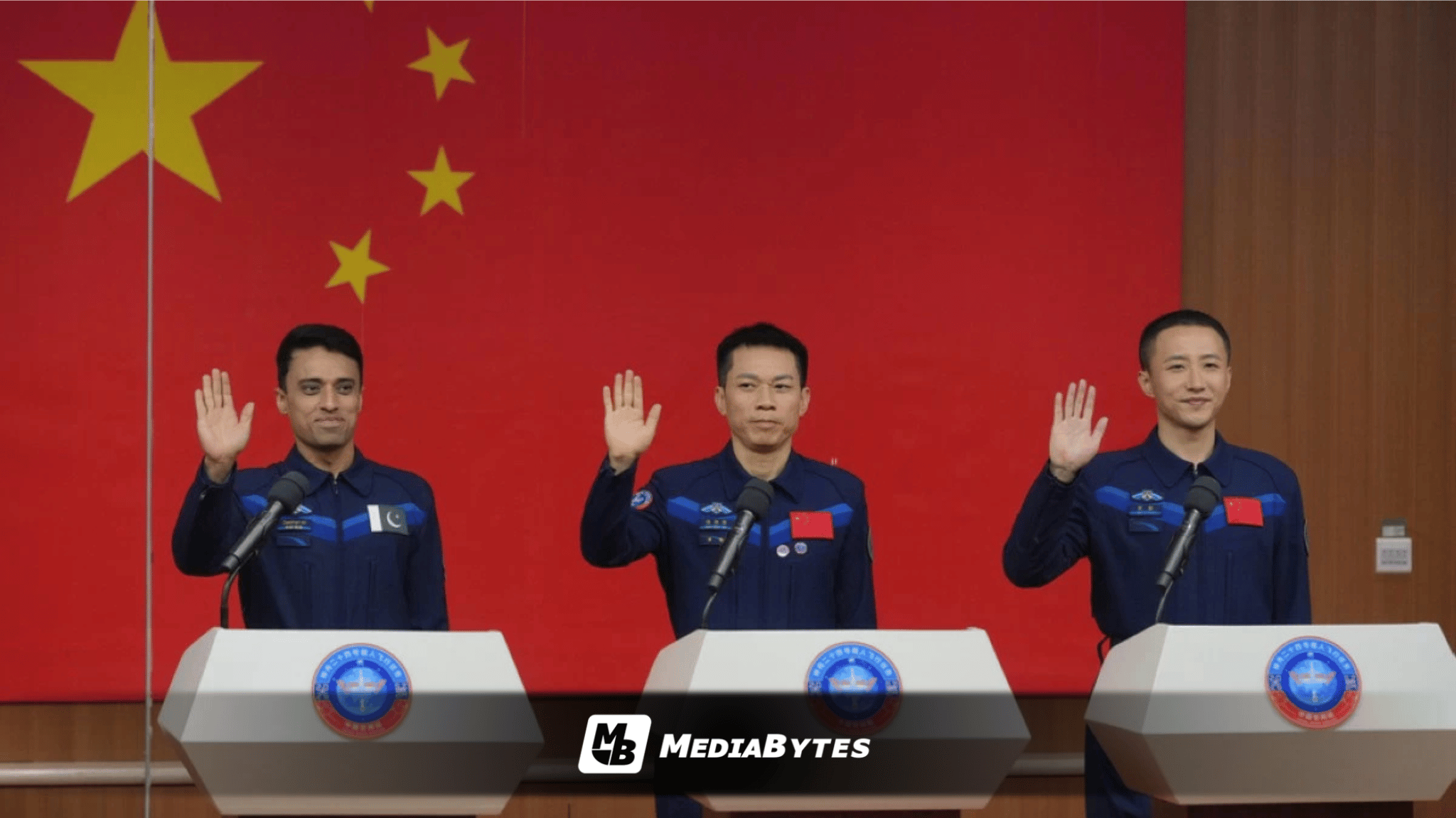
JIUQUAN, China — China has announced the three-person crew for its Shenzhou 24 mission, featuring Pakistani astronaut Muhammad Zeeshan Ali, who will become the first foreign national to board the country’s Tiangong space station.
According to the China Manned Space Agency via official news agency Xinhua, the 40-year-old Ali will fly alongside Chinese astronauts Tang Hongbo, 51, and Wu Yi, 39. The spacecraft is scheduled to lift off Wednesday morning from the Jiuquan Satellite Launch Center in northwest China.
Stemming from a bilateral agreement signed in February 2025, the mission marks the first joint spaceflight between Chinese and foreign astronauts in the history of China’s crewed space program.
During a press briefing with the crew, Ali—a former air force pilot—expressed his gratitude to the Chinese government for realizing his lifelong ambition. Speaking in Mandarin, he referenced a classic line of Chinese poetry about climbing a story higher to broaden one’s view.
“It’s like my daily training. Day after day, reaching new heights,” he said in Mandarin.
Switching to English, Ali described the flight not as a “finish line,” but as the start of a longer journey, voicing hope that bilateral space cooperation will eventually expand to multiple joint missions reaching the Moon, Mars, and beyond.
“To every child who’s watching while I’m in orbit,” he said. “Look up at the sky and remember that I am up there with your dreams.”
State broadcaster CCTV reported that Ali will serve as a payload specialist on a short-term stay, overseeing daily operations and four joint scientific experiments in biotechnology and materials, including a study on photosynthetic microorganisms. Following his brief stint in orbit, he will return to Earth aboard the Shenzhou 23 spacecraft.
While the mission represents the maiden spaceflight for both Ali and Wu, veteran astronaut Tang is set to become the first person to enter the Tiangong station three times. Tang acknowledged that linguistic, cultural, and psychological differences initially made crew integration challenging, though mutual dedication helped bridge the gap.
“The labels and operating instructions aboard the spacecraft and space station are all in Chinese, and the Pakistani astronaut began training with virtually no foundation of the language,” Tang noted, adding that both he and Wu worked to improve their English skills in return.
The historic launch comes as China advances toward its goal of landing astronauts on the Moon by 2030, competing directly with the United States, where NASA targets a crewed lunar landing in 2028.