


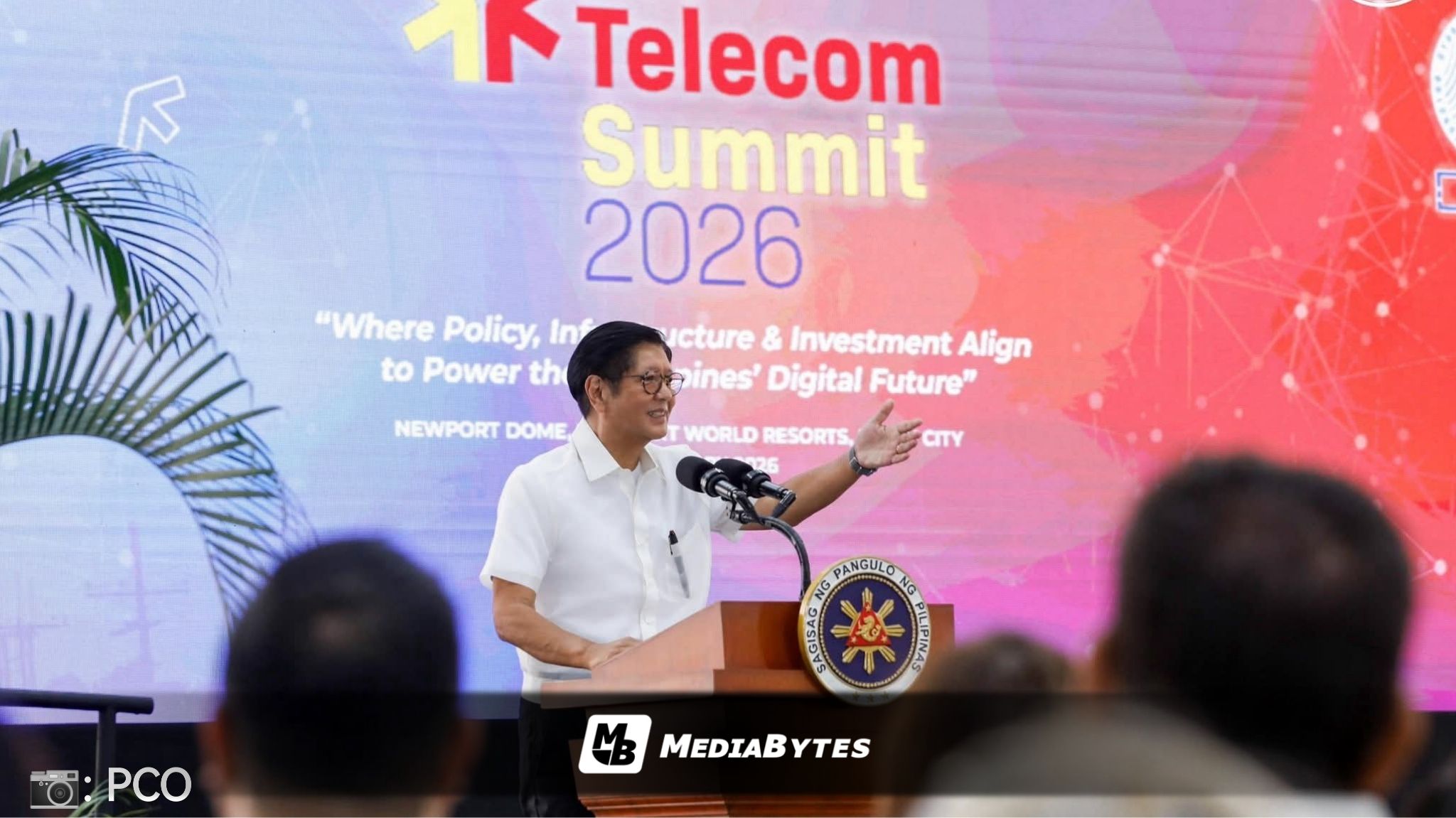
President Ferdinand “Bongbong” Marcos Jr. on Thursday reaffirmed his administration’s commitment to address the country’s long-standing internet problems, promising quicker reforms to deliver faster, more affordable, and more reliable broadband services nationwide.
Speaking at the Philippine Telecommunications Summit 2026 in Pasay City, Marcos underscored connectivity as both an economic necessity and a basic public service, noting that Filipinos remain among the world’s heaviest internet users despite paying high costs for slower speeds.
“Kasama ang Department of Information and Communications Technology, isinusulong natin ang mas mabilis na reporma upang maging mas mabilis at abot-kaya ang ating mga binibigay na internet services,” Marcos said.
“Kasabay nito, patuloy nating pinapalawak ang saklaw ng konektibidad sa buong bansa,” he added.
Central to the administration’s digital agenda is the Konektadong Pinoy Act, which removed the requirement for a congressional franchise to build and operate data transmission networks. The reform aims to open the sector to more players, boost competition, and accelerate network rollout.
“The law mandates infrastructure sharing and co-location among providers—ending wasteful duplication, lowering deployment costs, and ensuring that every single peso spent delivers real value to our public,” Marcos said.
The President also highlighted gains under the National Fiber Backbone Project, with Phases 1, 2, and 3 now linking hundreds of government agencies nationwide. Phase 1 connected 360 agencies serving over 10 million Filipinos, while later phases expanded coverage to about 690 agencies, benefiting nearly 17 million people.
Marcos cited the continued expansion of the Free Public Internet Access Program, now with more than 9,500 active Wi-Fi sites across over 5,000 public locations, including schools, hospitals, and transport hubs.
To narrow the digital divide, he pointed to the Bayanihan SIM Card Project, which has distributed over 89,400 subsidized SIM cards with monthly data to students, teachers, and low-income families.
The President also thanked private telecommunications firms for committing new investments, saying government reforms are meant to unlock growth and improve services for the public.