


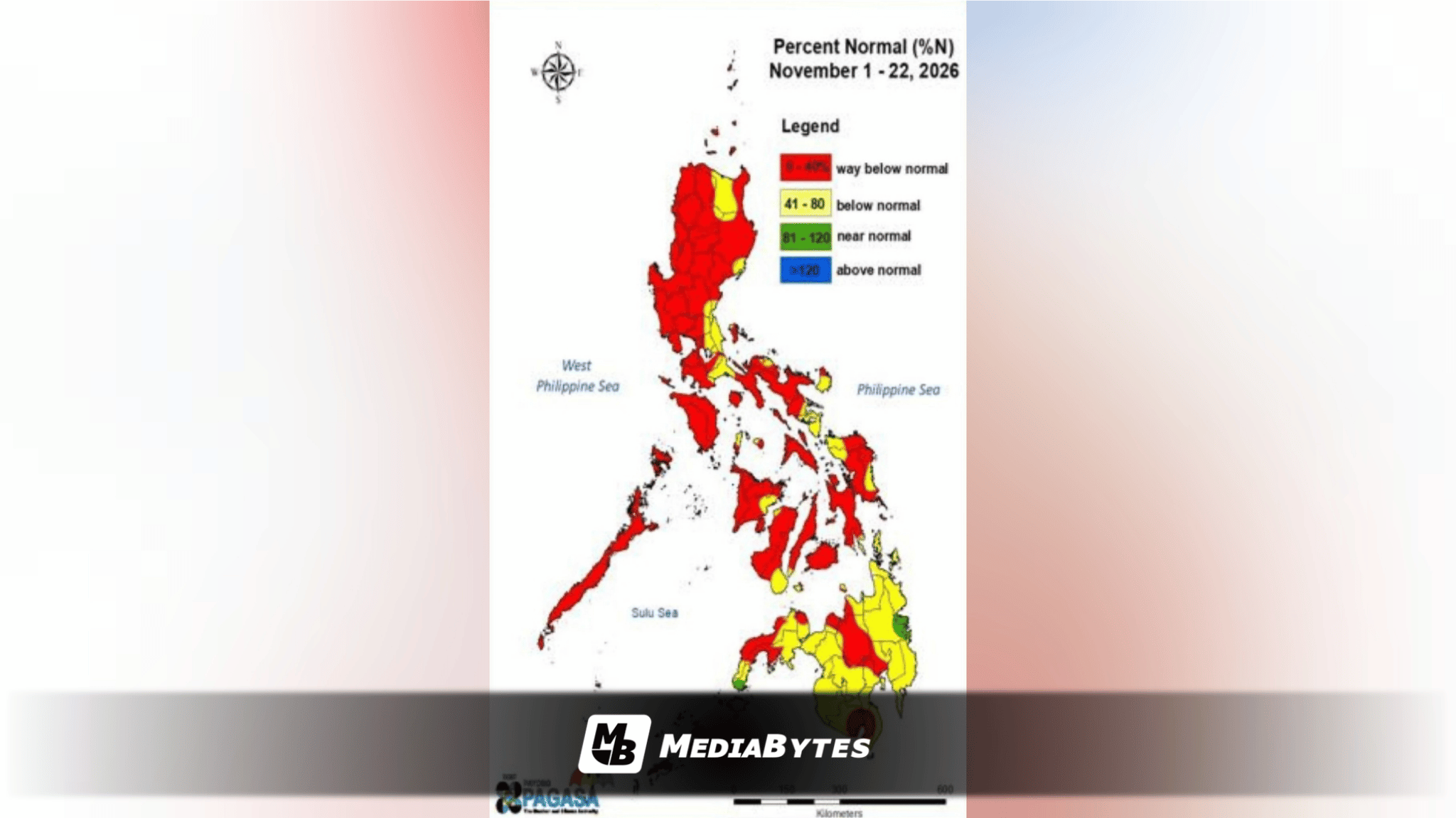
MANILA, Philippines — The number of areas across the Philippines experiencing drier-than-usual conditions nearly doubled from 26 in October to 51 in November as a very strong El Niño continues to suppress nationwide rainfall.
During a climate outlook forum on Wednesday, November 25, Philippine Atmospheric, Geophysical and Astronomical Services Administration (PAGASA) weather specialist Dr. Joseph Basconcillo presented the agency’s latest climate assessment.
As of November 22, 60 areas recorded way-below-normal rainfall—defined as a reduction of more than 60% from the average—while 27 areas experienced below-normal rainfall, or a 21% to 60% decline. This marks a sharp shift from October, when Mindanao still received near-normal to above-normal rain.
Of the 51 affected areas, nine are currently under drought (three consecutive months of way-below-normal rainfall): Albay, Catanduanes, Biliran, Capiz, Negros Occidental, Negros Oriental, Samar (Western Samar), Siquijor, and Sarangani.
Another 29 areas are experiencing a dry spell (three consecutive months of below-normal rainfall): Abra, Apayao, Bataan, Batanes, Batangas, Benguet, Cagayan, Cavite, Ifugao, Ilocos Norte, Ilocos Sur, Isabela, Kalinga, La Union, Marinduque, Masbate, Mountain Province, Oriental Mindoro, Quezon, Quirino, Sorsogon, Zambales, Aklan, Iloilo, Northern Samar, Southern Leyte, Agusan del Norte, Dinagat Islands, and Surigao del Norte.
Meanwhile, 13 areas are under a dry condition (two consecutive months of below-normal rainfall), including Metro Manila, Aurora, Bulacan, Palawan (Kalayaan), Laguna, Nueva Ecija, Nueva Vizcaya, Occidental Mindoro, Pampanga, Pangasinan, Rizal, and Eastern Samar.
PAGASA, which confirmed on November 4 that El Niño had escalated into a “very strong” episode, noted that hotter-than-usual temperatures persist across most of the country. Echague, Isabela recorded the nation’s highest temperature this month at 36.9 degrees Celsius on November 17, while Pasay City logged Metro Manila’s peak at 35 degrees Celsius on November 2.
Conversely, periodic surges of the northeast monsoon, locally known as “amihan,” still brought localized cold snaps. La Trinidad, Benguet registered the country’s lowest temperature at 7 degrees Celsius on November 17, while the Science Garden station in Quezon City recorded Metro Manila’s lowest at 20.6 degrees Celsius on November 5.