


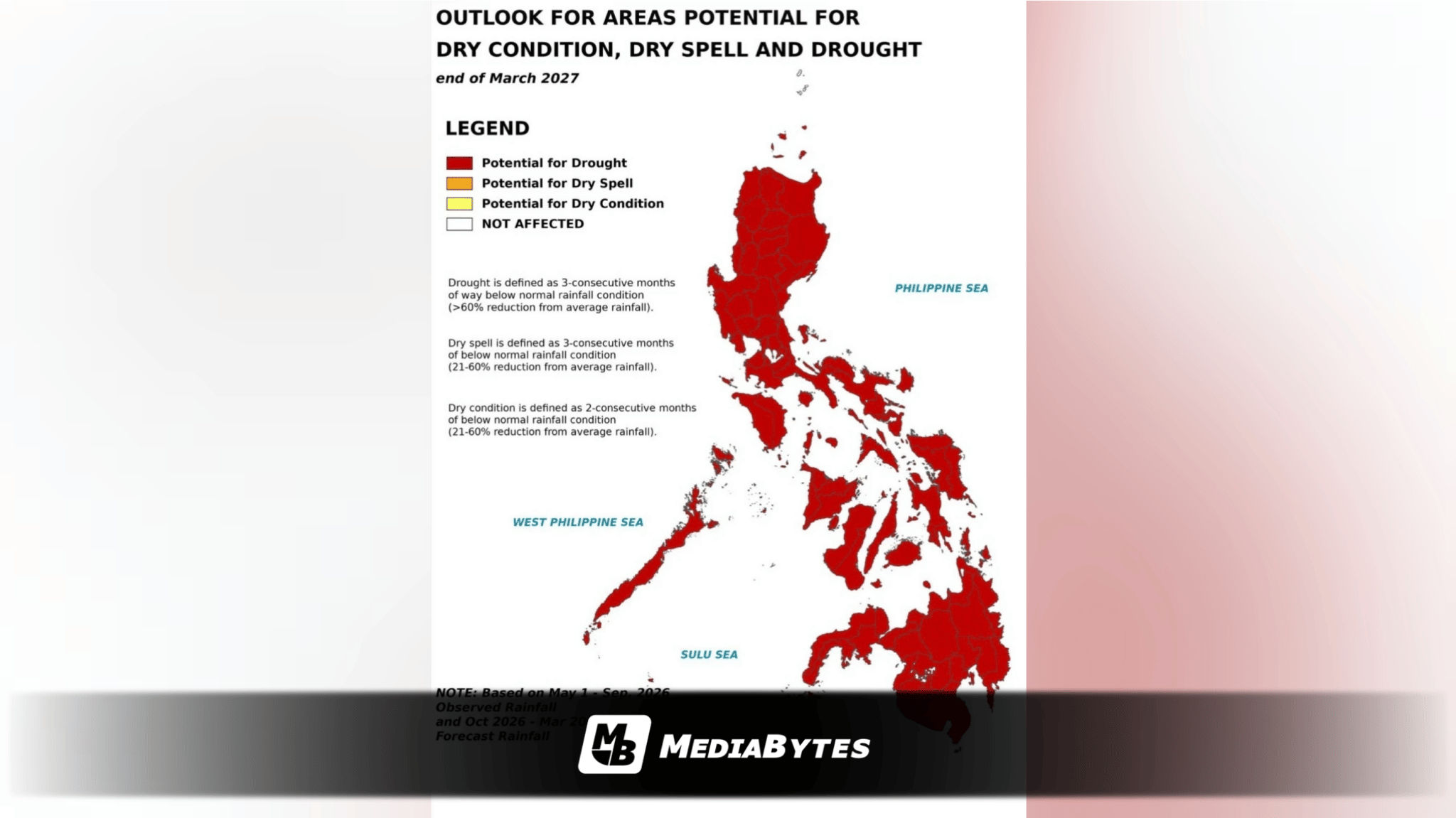
QUEZON CITY, Philippines — Expanding rainfall deficits triggered by an ongoing El Niño are projected to plunge the entire country into meteorological drought by March 2027, according to the state weather bureau.
The Philippine Atmospheric, Geophysical and Astronomical Services Administration (PAGASA) released a multi-month outlook detailing how prolonged dry spells will progressively cover provinces across Luzon, the Visayas, and Mindanao from October 2026 through the first quarter of 2027.
PAGASA categorizes dry weather conditions into three distinct stages based on the severity and duration of rainfall reduction:
- Dry Condition: Occurs when an area receives 21% to 60% below-normal rainfall for two consecutive months.
- Dry Spell: Defined by three straight months of below-normal rainfall, or two consecutive months of severe deficit (more than 60% below average).
- Drought: Marked by more than 60% below-normal rainfall for three consecutive months, or below-normal rainfall persisting for five consecutive months.
According to PAGASA data as of October 1, 30 areas were recorded under dry condition, three under dry spell, and seven under drought at the end of September.
The dry condition category includes Masbate, Sorsogon, Biliran, Bohol, Cebu, Negros Occidental, Northern Samar, Southern Leyte, Agusan del Norte, Basilan, Bukidnon, Camiguin, Cotabato, Davao del Sur, Davao Occidental, Dinagat Islands, Lanao del Norte, Lanao del Sur, Maguindanao del Norte, Maguindanao del Sur, Misamis Occidental, Sarangani, South Cotabato, Sultan Kudarat, Sulu, Surigao del Norte, Tawi-Tawi, Zamboanga del Norte, Zamboanga del Sur, and Zamboanga Sibugay.
Meanwhile, Capiz, Leyte, and Misamis Oriental were placed under dry spell, while Albay, Camarines Norte, Camarines Sur, Catanduanes, Negros Oriental, Samar, and Siquijor were already experiencing drought.
Projections indicate a steady intensification of the phenomenon over the coming months:
- End of October: 12 areas will face dry conditions (including Abra, Isabela, Kalinga, Marinduque, Oriental Mindoro, Palawan, Quezon, Romblon, Aklan, Antique, Guimaras, and Iloilo); eight under dry spell (including Masbate, Sorsogon, Biliran, Northern Samar, Southern Leyte, Agusan del Norte, Dinagat Islands, and Surigao del Norte); and six under drought (Albay, Camarines Norte, Camarines Sur, Catanduanes, Leyte, and Samar).
- End of November: 25 regions will fall under dry conditions (including Metro Manila, Bataan, Bulacan, Pampanga, and Pangasinan); 19 under dry spell (including Abra, Isabela, Palawan, and Iloilo); and six remain under drought (Albay, Camarines Norte, Camarines Sur, Catanduanes, Leyte, and Samar).
- End of December: Dry conditions will affect 30 areas; dry spells will spread to 33 provinces (including Metro Manila and major Northern/Central Luzon provinces); and drought will expand to 17 areas (including Isabela, Marinduque, Masbate, Oriental Mindoro, Sorsogon, and several Visayas and Mindanao provinces).
- End of January: Drought will cover 45 areas (including Metro Manila, Abra, Bataan, Batangas, Ilocos Norte, and Pampanga), with 35 under dry spell and only five under dry condition.
- End of February: Drought will affect 78 areas across Luzon, Visayas, and Mindanao, leaving just seven areas under dry spell (Agusan del Norte, Agusan del Sur, Davao City, Davao de Oro, Davao del Norte, Davao Oriental, and Surigao del Sur) and zero areas under simple dry condition.
- End of March: The entire country is forecasted to be under full meteorological drought.
PAGASA noted that the current “strong” El Niño event is likely to persist through the mid-2027 period, with climate models indicating it could reach a “very strong” intensity near the end of 2026.