


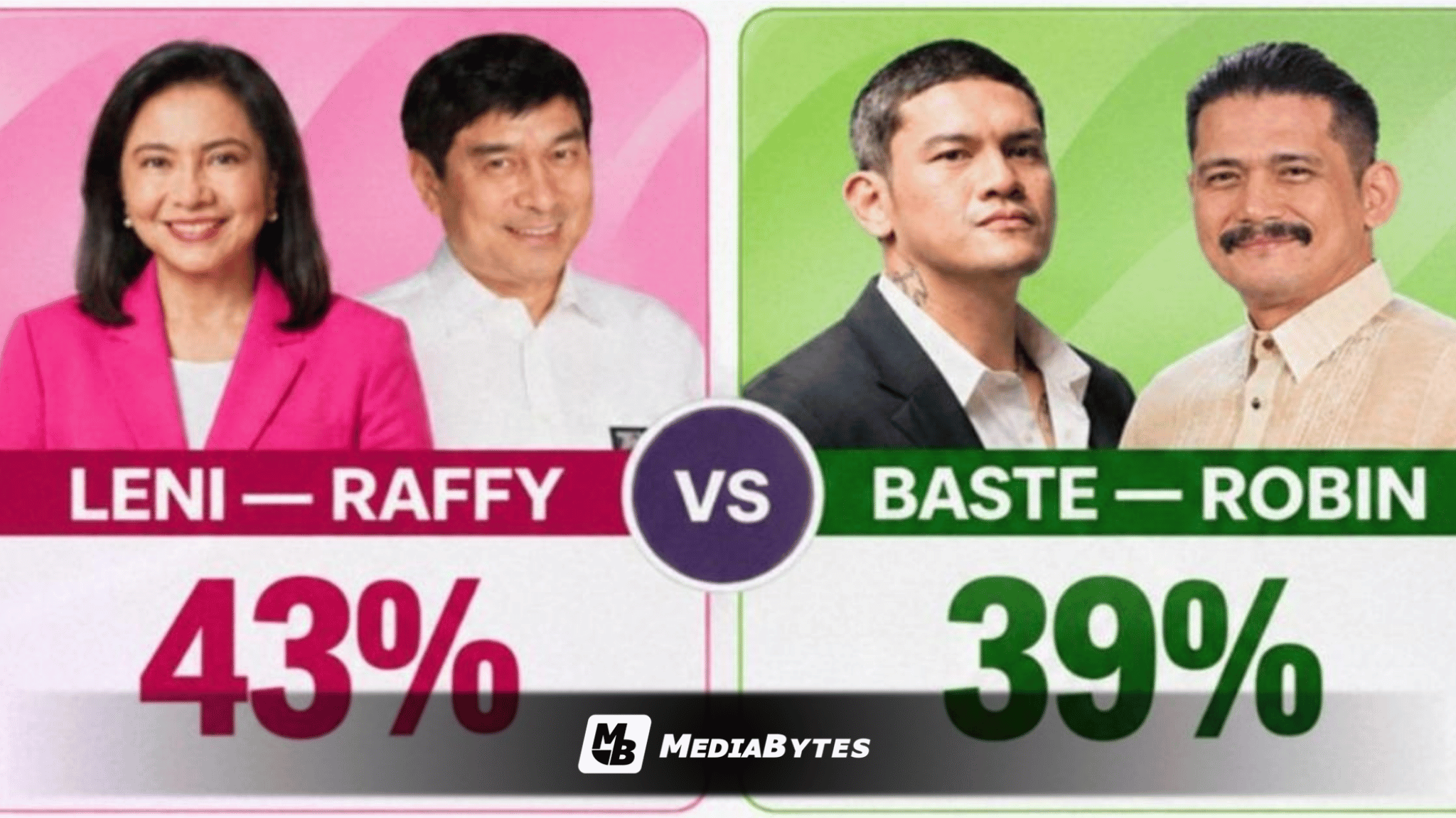
A hypothetical 2028 presidential and vice presidential matchup by OCTA Research shows former Vice President and Naga City Mayor Leni Robredo paired with Senator Raffy Tulfo leading a ticket against Davao City Mayor Sebastian “Baste” Duterte and Senator Robin Padilla.
According to OCTA’s first 2028 Tugon ng Masa survey conducted from September 28 to October 4, 2026, the Robredo-Tulfo tandem secured 43 percent of nationwide support among adult Filipinos. The Duterte-Padilla ticket followed with 39 percent, while 18 percent remained uncommitted or chose neither.
Among registered voters, the figures stood at 43 percent, 40 percent, and 17 percent, respectively.
The four-point national lead sits just above the survey’s ±3 percent margin of error at a 95 percent confidence level. OCTA noted that the independent poll reflects preferences gathered through face-to-face interviews with 1,200 respondents, nearly 19 months prior to the May 2028 elections.
The findings were published shortly after Mayor Robredo reaffirmed on November 9 that she will not seek the presidency and will instead run for a second term as Naga City’s chief executive.
“While OCTA acknowledges Mayor Leni Robredo’s statement, it should be stressed that the survey was conducted from September 28 to October 4, 2026 — more than a month before her November 9 statement — and therefore does not reflect any public reaction to it,” OCTA stated.
Neither Mayor Baste Duterte nor Senator Tulfo has declared a presidential bid, and neither pairing is an official ticket. OCTA emphasized that the poll serves as a baseline rather than a forecast, noting that voter preferences are likely to shift as candidacies, political alliances, public issues, and ongoing proceedings—such as the Senate impeachment trial of Vice President Sara Duterte, which coincided with the fieldwork—develop.
Regional and Demographic Divides
The data reveals distinct geographic and ethnolinguistic alignments between the two voter bases.
The Robredo-Tulfo coalition finds its primary anchor in Luzon, leading by wide margins in Balance Luzon (61 percent to 19 percent), North Luzon (69 percent), the National Capital Region (49 percent to 32 percent), and among Tagalog/Filipino (54 percent to 24 percent) and Ilocano (80 percent to 8 percent) respondents. Approximately 80 percent of its voter base resides in Luzon.
Conversely, the Duterte-Padilla coalition anchors heavily in Mindanao and Central Visayas. The tandem leads 81 percent to 4 percent in Mindanao—with strong majorities in the Davao Region, SOCCSKSARGEN, CARAGA, and BARMM—as well as 79 percent in Central Visayas. The ticket also leads 75 percent to 10 percent among Cebuano/Bisaya respondents, with nearly half of its supporters residing in Mindanao.
Meanwhile, certain segments remain closely contested, including the Visayas region overall, Class D socioeconomic brackets, high school-educated respondents, and younger voters aged 18 to 24.
The 18 percent uncommitted bloc is largely concentrated in younger demographics and South Luzon, particularly in CALABARZON and rural South Luzon.