


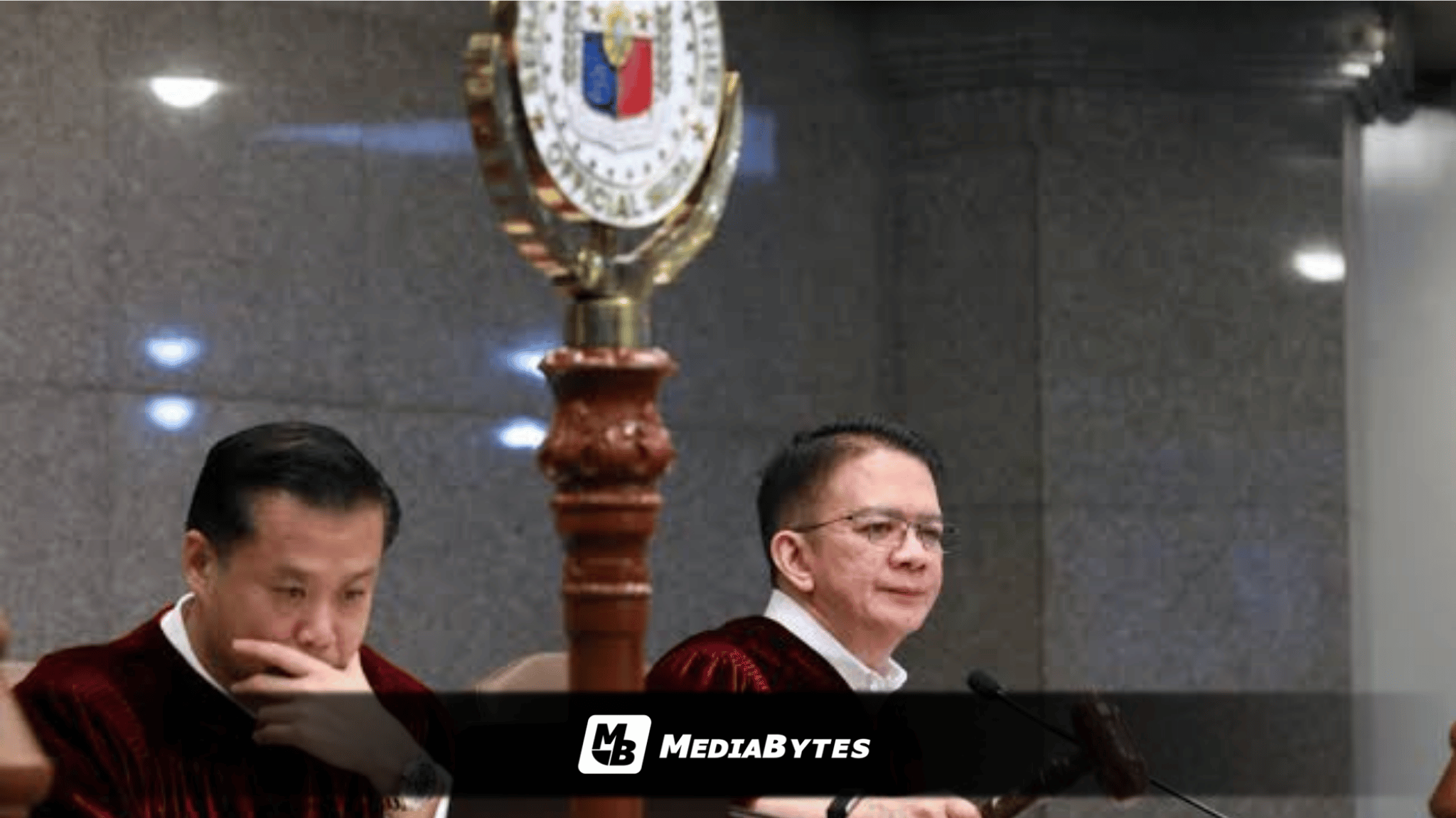
MANILA, Philippines — A second petition was submitted to the Supreme Court (SC) on Friday, September 25, asking the High Tribunal to invalidate a recent Senate Impeachment Tribunal decision that lowered the required vote count to convict an impeached official.
Filed by Atty. Ernesto Francisco Jr., the legal challenge requests an immediate order directing the Senate to restore the voting threshold to a strict two-thirds majority of all 24 constitutional members—or 16 votes—as specified under the 1987 Constitution.
The action follows a similar petition submitted by former Executive Secretary Vic Rodriguez. Both petitioners are seeking injunctive relief to halt the enforcement of the tribunal’s September 23 decision.
In that 13-1 ruling, the Senate, sitting as an Impeachment Tribunal, voted to reconsider its previous stance and reduce the required conviction tally from 16 votes to 14.
Article XI, Section 3(6) of the 1987 Philippine Constitution outlines the mandate for impeachment proceedings:
”The Senate shall have the sole power to try and decide all cases of impeachment. When sitting for that purpose, the Senators shall be on oath or affirmation. When the President of the Philippines is on trial, the Chief Justice of the Supreme Court shall preside, but shall not vote. No person shall be convicted without the concurrence of two-thirds of all the Members of the Senate.”
In his submission, Francisco argued that the tribunal’s ruling bypassed proper legislative channels to alter the constitutional standard.
“was not merely a constitutional interpretation, but a constitutional amendment.”
“Such action constitutes a capricious and arbitrary departure from the plain language of the 1987 Philippine Constitution, correctible through the Honorable Court’s power of judicial review,” he stressed.
Francisco maintained that the Senate committed grave abuse of discretion by modifying a constitutional mandate “through a mere procedural ruling, and declaring that the same is ‘the new controlling ruling of the court’ in the determination of the two-thirds concurrence required for conviction under Article XI, Section 3(6) of the 1987 Philippine Constitution.”
Clarifying his prayer before the High Court, Francisco noted that he is not asking the justices “to pass upon the merits of the impeachment charges or direct any Senator-Judge how to vote,” but rather to ensure the tribunal adheres strictly to constitutional framework.
Addressing the status of absent lawmakers, Francisco argued that temporary unavailability does not remove a sitting lawmaker from the total membership tally.
“A senator remains a senator until his or her office is constitutionally vacated. In this regard, none of the circumstances enumerated in the Sept. 23, 2026 ‘ruling’ of the public respondent Senate Impeachment Court could be equated to a vacancy.”
“a detained senator, a senator on medical leave, or a senator temporarily absent remains a constitutional member of the Senate. Membership pertains to constitutional status, not actual participation.”
“Thus, to permit the denominator to vary according to the factual circumstances of individual senators would make constitutional membership dependent upon convenience rather than constitutional status,” he also said.
In the earlier petition, Rodriguez urged the High Court to nullify the September 23 decision “insofar as it reduces or permits the reduction of the constitutional denominator by excluding incumbent Senators merely because they are absent, nonparticipating, unable to participate, beyond the coercive processes of the Senate, or otherwise deemed similarly situated.”
Rodriguez further urged the SC to reinstate an earlier July 6 ruling “insofar as it recognizes that, with a legally constituted Senate of twenty-four Members, two-thirds requires sixteen (16) votes.”
“The Senate, sitting as an impeachment tribunal, has effectively altered the operative meaning of Article XI, Section 3(6) without employing any of the methods by which the Constitution itself may be amended or revised under Article XVII.”
“The challenged ruling potentially establishes a principle under which the constitutional voting requirement in impeachment may be altered depending upon the number of Senators whom the Tribunal determines to be capable of participating. The consequence would extend beyond the present impeachment proceeding. It would establish a mechanism whereby an express constitutional voting requirement could be modified by a ruling of the very body whose powers are being regulated by that constitutional provision.”