


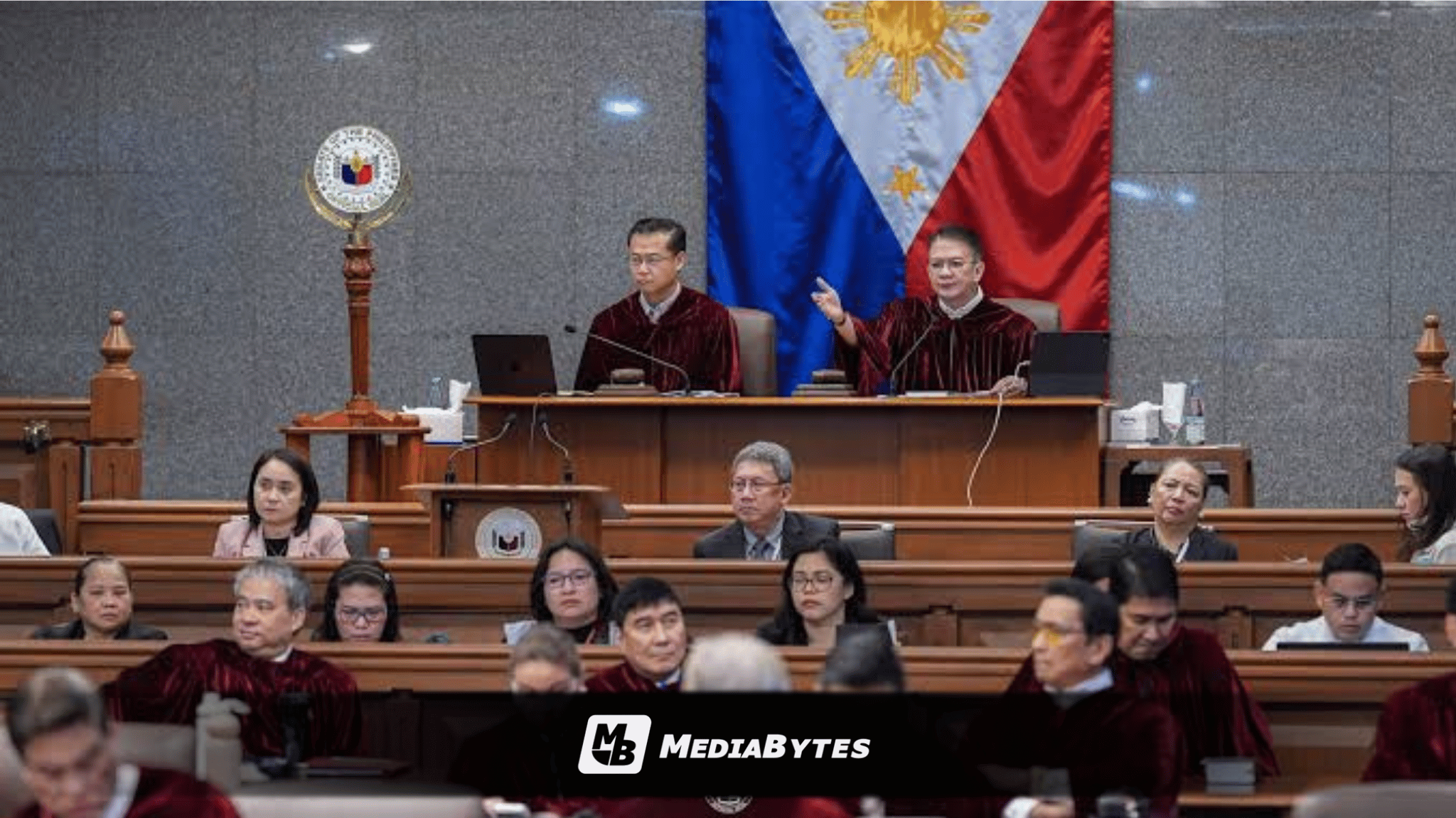
PASAY CITY, Philippines — The Senate impeachment court voted on Wednesday, September 23, to reverse its earlier ruling that required 16 votes to convict Vice President Sara Duterte, allowing the constitutional two-thirds requirement to be computed solely from senators who are legally and factually able to participate.
The tribunal voted 13-1, with six senators abstaining from the vote, to grant the appeal of Senator Erwin Tulfo. Tulfo’s motion challenged the July 6 ruling of presiding officer Francis “Chiz” Escudero, which had defined “all the Members of the Senate” as the entire 24-member chamber.
Escudero noted that approving Tulfo’s appeal overturned his original decision, establishing a new interpretation where the necessary two-thirds majority will be calculated using only those members who are actively capable of taking part in the proceedings.
Under the adjusted rule, the voting base will exclude lawmakers who are currently detained, suspended, or legally restricted from performing their duties, those whose locations are unknown and are evading authorities, individuals suffering from medical or physical incapacity, and those beyond the Senate’s coercive authority.
Because the final headcount depends on how many eligible senators are able to participate when judgment is delivered, the ruling does not fix a permanent numerical threshold.
Six senators refrained from participating in Wednesday’s vote: Alan Peter Cayetano, Pia Cayetano, Christopher “Bong” Go, Imee Marcos, Camille Villar, and Robinhood Padilla.
The 13 senators who voted in favor of Tulfo’s appeal were Senate President Win Gatchalian, Senate President Pro Tempore Vicente “Tito” Sotto III, Senate Majority Leader Juan Miguel “Migz” Zubiri, Senate Deputy Majority Leader JV Ejercito, Joel Villanueva, Bam Aquino, Francis “Kiko” Pangilinan, Risa Hontiveros, Lito Lapid, Panfilo “Ping” Lacson, Erwin Tulfo, Raffy Tulfo, and Mark Villar.
Escudero cast the lone dissenting vote.
“For the record, while the chair takes exception to this decision, the chair nonetheless accepts it as a judgment of this court and is bound to give it effect,” Escudero stated following the vote.
“The presiding officer, after all, is not the court. He is merely the custodian of the process, not the proprietor of it,” he added.
The presiding officer had initially ruled on the trial’s opening day that a strict 16-vote requirement—representing two-thirds of all 24 Senate seats—was mandatory for conviction. Tulfo contested the stance, arguing that incapacitated or absent members should not be included in the baseline count.
The court addressed Tulfo’s September 8 motion as a formal appeal against the initial ruling. Prior to the vote, the court reviewed input from retired Supreme Court justices acting as amici curiae and heard oral arguments from both parties.
Tulfo emphasized that the issue was about determining which senators can validly be counted in the final tally, rather than an attempt to lower the bar for conviction.
Emphasizing acceptance of the chamber’s decision, Escudero concluded:
“This is the essence of democracy that disagreement be preserved without obstruction and that lawful result be obeyed without resentment,” Escudero said.
“We allow the fullest ventilation of views, even if those views differ sharply from our own. But at the end of the day, we vote. We abide by the judgment of the majority, even if we disagree with it,” he added.