


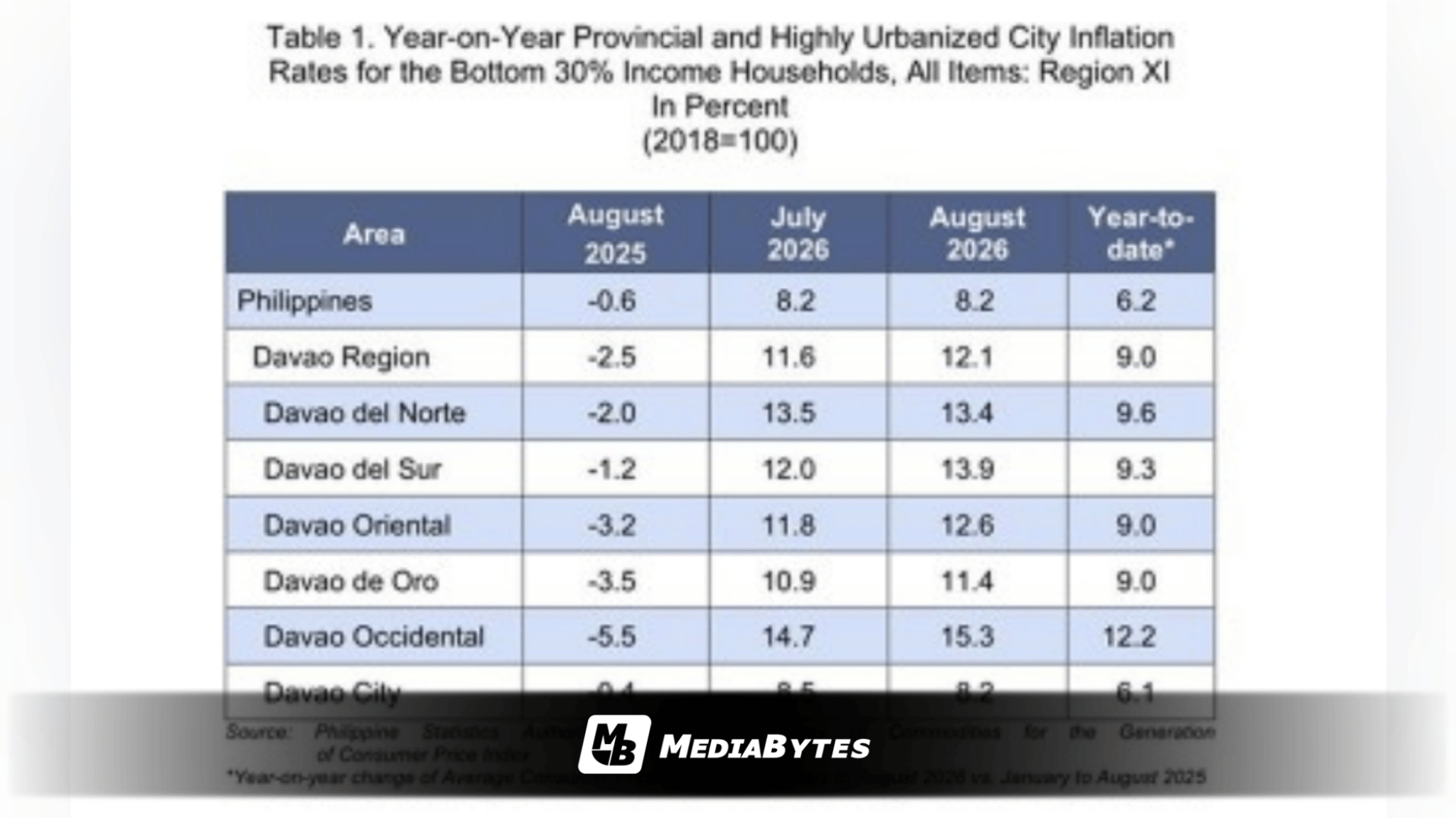
Low-income households in the Davao Region experienced higher cost-of-living pressures as inflation for the bottom 30% income segment rose to 12.1% in August 2026, up from 11.6% in July, based on official figures from the Philippine Statistics Authority-11 (PSA-11).
The August performance reflects a sharp contrast to the same month last year, when the inflation rate for this demographic registered at -2.5%.
Higher prices in basic consumables drove the overall upward trajectory across the region.
”The uptrend in the region’s overall inflation in August 2026 was primarily due to the faster year-on-year growth rate in the index of Food and Non-alcoholic Beverages, at 13.8% from 13.1%,” the PSA-11 noted in its report.
In addition to food and essential drinks, several key spending categories recorded accelerated annual price increases:
- Transport: jumped to 13.0% from 11.2%
- Recreation, Sport, and Culture: increased to 7.3% from 7.1%
- Alcoholic Beverages and Tobacco: rose to 7.1% from 6.6%
- Furnishings, Household Equipment, and Maintenance: picked up to 2.8% from 2.6%
- Clothing and Footwear: edged up to 2.5% from 2.4%
Conversely, price adjustments slowed down for housing, water, electricity, gas, and other fuels (16.2% from 16.9%), dining and lodging services (6.7% from 6.8%), and personal care items (4.5% from 4.6%). Rates remained stable for health (6.0%), education (3.6%), and information and communication (1.4%).
Food items served as the primary driver of overall inflation for low-income families, accounting for a 64.2% share (7.8 percentage points). Utility and housing costs followed with a 19.2% contribution (2.3 percentage points), while transport costs made up 6.8% (0.8 percentage points).
Food inflation specifically among bottom-income households climbed to 14.4% in August, moving up from 13.8% in July.
”In August 2025, food inflation was lower at -5.5%,” the agency stated.