


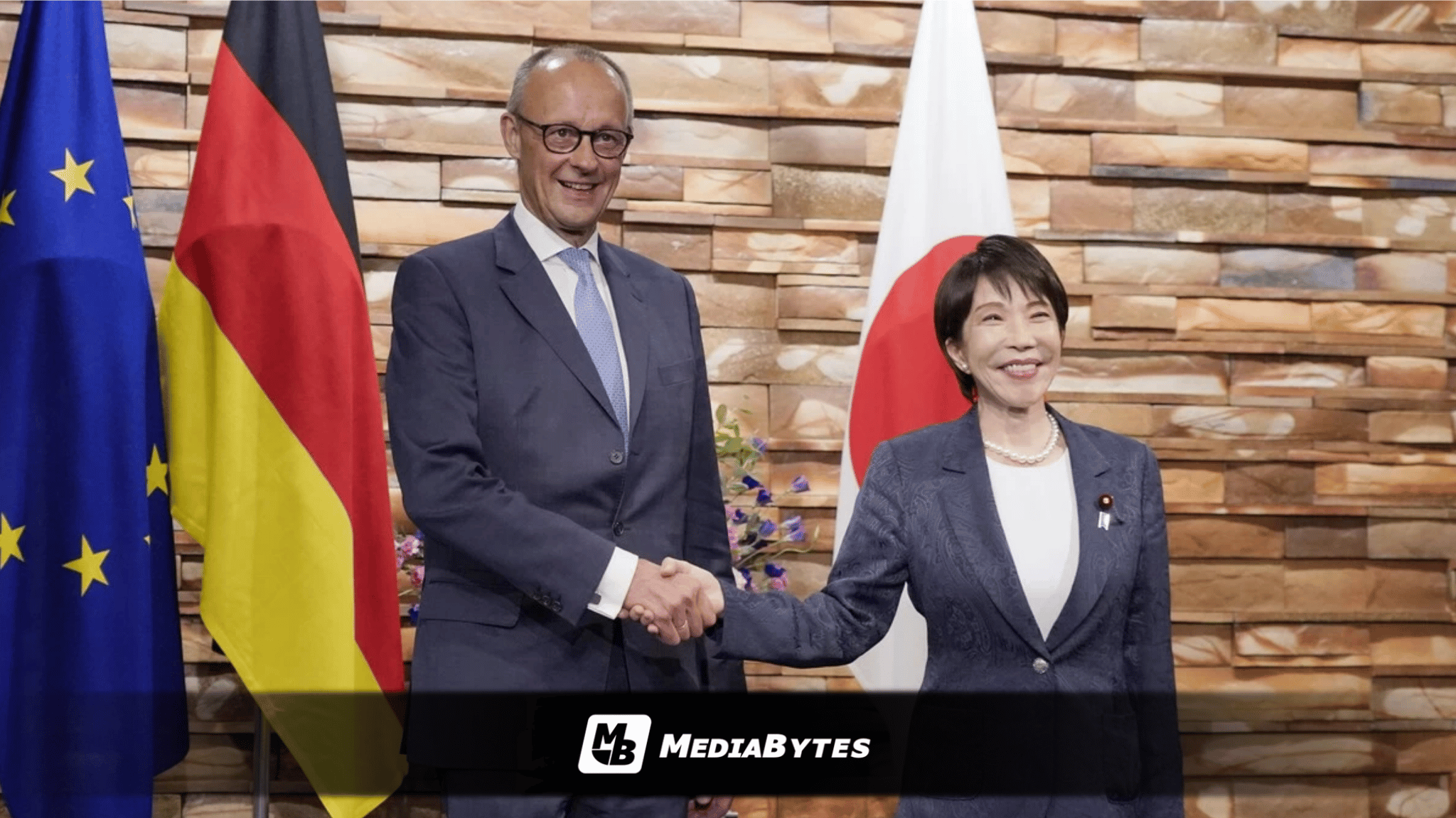
Japanese Prime Minister Sanae Takaichi and German Chancellor Friedrich Merz signed joint declarations in Tokyo focusing on economic security and cooperation in advanced technologies like artificial intelligence.
The meeting marked their first formal discussions since November of last year and served as Merz’s inaugural visit to Japan since taking office in May of the previous year.
During their summit at the prime minister’s office, the two leaders addressed geopolitical concerns, including Russia’s ongoing invasion of Ukraine and China’s expanding maritime and regional influence, ultimately committing to deepen bilateral defense and economic ties.
Addressing reporters at a joint press briefing, Takaichi emphasized the connection between global security arenas, stating:
”Security in the Euro-Atlantic region and the Indo-Pacific region is inseparable.”
Echoing these sentiments, Merz highlighted shared democratic values and common strategic interests between Berlin and Tokyo, noting that their partnership acts as a deterrent against unchecked actions by major powers—a remark widely interpreted as addressing China, Russia, and the United States.
”Japan and Germany share similar interests and values and that the two working together could prevent major powers from doing whatever they want,” Merz said.
To strengthen military ties, Takaichi noted she will explore frameworks to facilitate deeper cooperation between the German military and Japan’s Self-Defense Forces, alongside reciprocal defense industry initiatives.
Expanding on this, Merz signaled Germany’s desire to collaborate on fighter jet manufacturing and potentially join the Global Combat Air Program, a next-generation fighter development project currently shared by Japan, Britain, and Italy.
Amid mounting supply chain vulnerabilities and China’s export restrictions on critical materials and semiconductors, both leaders agreed to fortify supply chains for strategic goods. They also established a high-level dialogue dedicated to artificial intelligence.
Furthermore, Merz formally invited Prime Minister Takaichi to visit Berlin next year. Addressing regional stability, Merz voiced anxieties regarding the Taiwan Strait, urging restraint from all involved parties and reiterating that the United Nations Charter’s principle against the use of force applies directly to the area.
On the trade and industrial front, Takaichi and Merz discussed balancing national industrial interests, particularly following Japan’s previous exclusion from the European Union’s preferential vehicle subsidies—an initiative originally pushed by Germany and France.
The push for closer relations aligns with Germany’s broader strategy to diversify trade and diminish its heavy economic reliance on both the United States and China.
Accompanied by approximately 30 corporate executives on his delegation, Chancellor Merz oversaw the signing of 33 memorandums of understanding spanning artificial intelligence, nuclear fusion, and other cutting-edge technological sectors.