


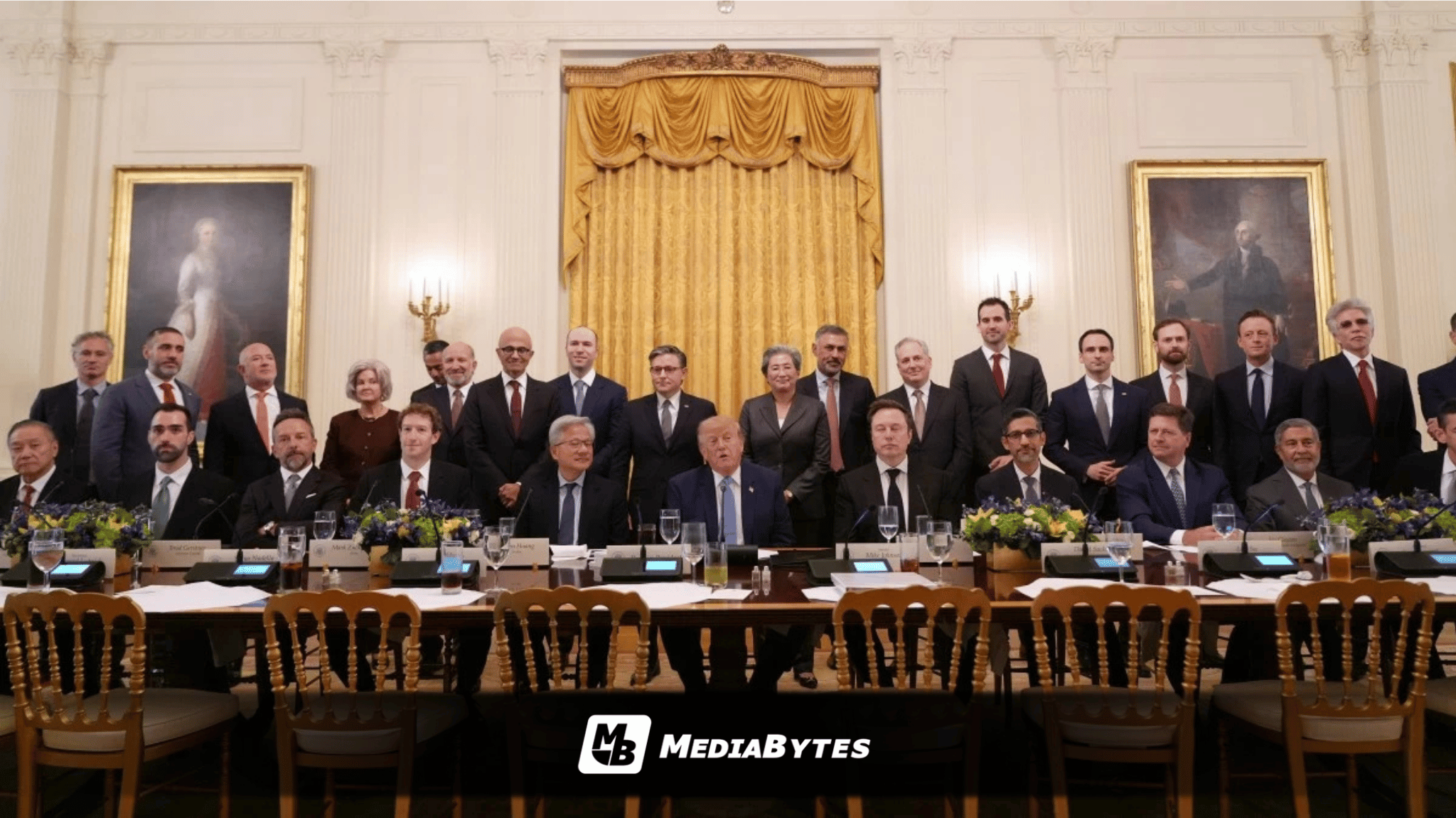
WASHINGTON — U.S. President Donald Trump announced Tuesday, September 30, that he and leaders from prominent artificial intelligence firms signed a voluntary agreement establishing internal and external evaluations following a White House meeting aimed at addressing public safety concerns.
Speaking to reporters outside the West Wing during an unannounced press conference, Trump expressed confidence in industry oversight.
“I think I’m seeing tremendous self-policing. And they understand that they have to self-police,” Trump said.
Trump, joined by House Speaker Mike Johnson, hosted executives from tech companies investing heavily in national AI infrastructure. These investments include nationwide data center builds that have sparked grassroots resistance from both political parties.
The pact was signed by Trump alongside Anthropic CEO Dario Amodei, Google CEO Sundar Pichai, Meta CEO Mark Zuckerberg, OpenAI President Greg Brockman, Nvidia CEO Jensen Huang, and xAI founder Elon Musk, whose company operates under SpaceX.
Published by Trump on Truth Social late Tuesday, the document allows for future legislation while outlining four main voluntary commitments from the signatory firms.
Under the framework, participating businesses pledged to implement “robust internal controls,” submit to reviews by an “independent external auditor” to gauge control efficacy, and form a board-level oversight committee within each organization to evaluate internal and third-party findings.
“Over time, it may make sense to codify these steps into laws and regulations,” the accord stated.
Trump frequently praised the technology leaders for advancing capabilities that he asserted would spark “unbelievable growth.”
High levels of capital expenditure on data centers and advanced hardware have spurred economic output and boosted stock values, benefiting high-net-worth investment portfolios and consumer spending.
However, some executives expressed reservations during the event. Amodei, a prominent advocate for a measured approach to AI acceleration, emphasized the potential hazards.
“The technology has very real risks,” Amodei said.
“And, you know, the mechanism, how we address those risks is still under discussion,” Amodei added.