


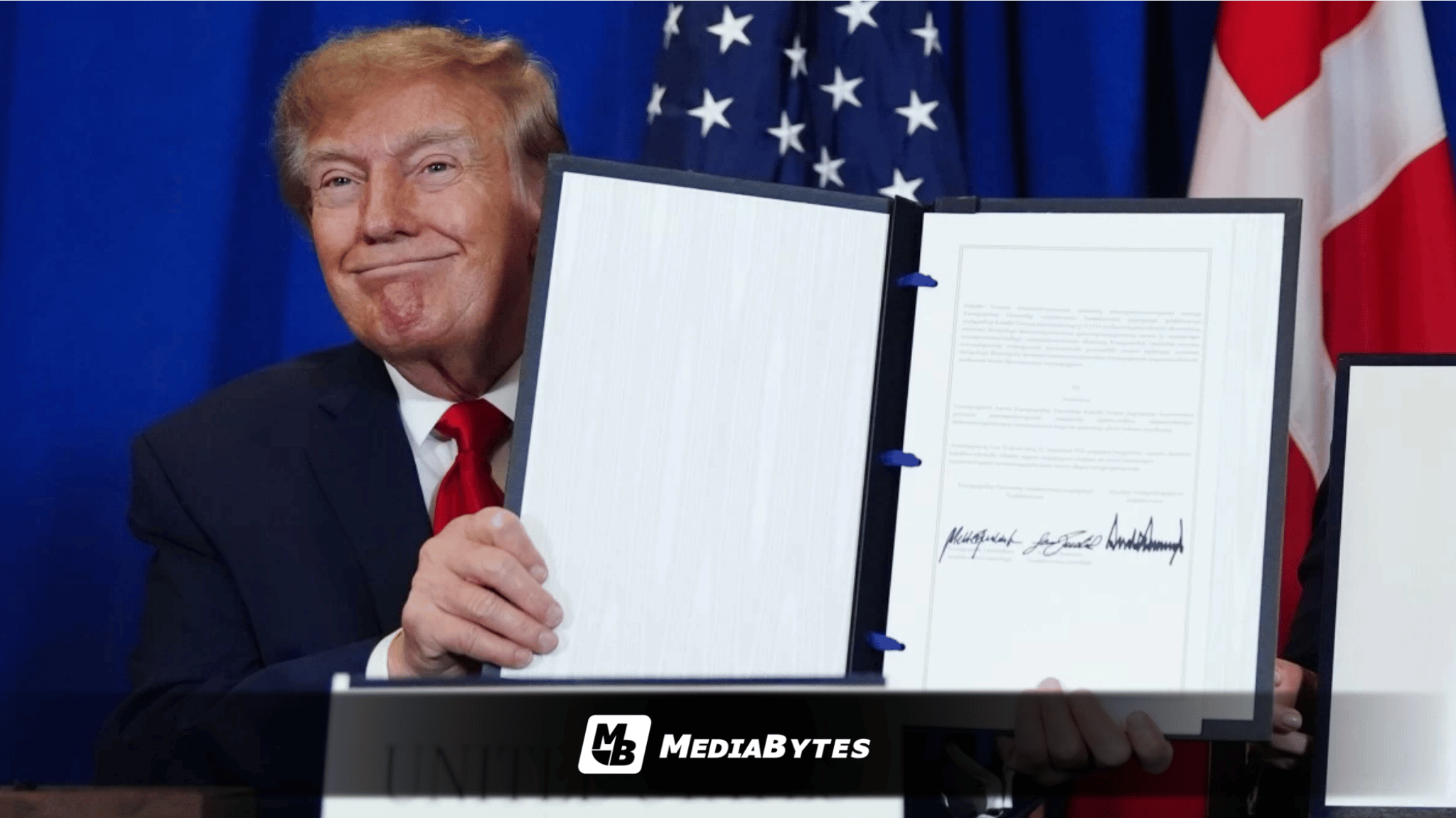
NEW YORK, United States — U.S. President Donald Trump signed a historic trilateral security agreement with Denmark and Greenland on Tuesday to enhance defense cooperation across the Arctic and North Atlantic, paving the way for an expanded American military footprint on the strategic island.
The pact was finalized on the sidelines of the United Nations General Assembly in New York following months of discussions involving American, Danish, and Greenlandic representatives.
While the accord grants U.S. forces broader operational access, it explicitly preserves Danish sovereignty over the territory.
“This is tremendous for Europe and for the United States and for everybody,” Trump remarked prior to the signing. “And for Greenland, it’s going to be incredible.”
Under the terms of the deal, Washington gains authorization to upgrade and expand facilities at Pituffik Space Base in northwestern Greenland, as well as establish new defense zones at Mestersvig in the east and Narsarsuaq in the south. The parties may also agree to designate further defense areas in the future.
The treaty grants American military aircraft overflight and landing rights across Greenland, while U.S. public vessels are permitted access to its territorial waters according to the agreed provisions.
Although Trump previously floated the idea of bringing the Arctic island under direct U.S. control in 2019 and sparked friction with NATO ally Denmark during his second term over the matter, the newly signed document does not cede sovereignty to Washington. Danish and local authorities maintain jurisdictional sovereignty, with the agreement formally acknowledging the right of Greenlanders to self-determination.
Furthermore, the framework remains binding should Greenland attain independence in the future, provided it retains NATO membership.
Trump had earlier argued that establishing American control was necessary to counter potential security encroachments by Russia or China. Rather than transferring ownership, the compromise broadens American defense capabilities and sets mechanisms aimed at preventing hostile military operations in the region.
Speaking ahead of the ceremony, Trump stated that the U.S. would “immediately begin the process of developing a large military presence in the appropriate locations,” including “building two very major military bases.”
The strategic significance of the Arctic has escalated rapidly amid intensified geopolitical rivalries and changing environmental access. Greenland’s geographic positioning remains critical for North American continental defense and Atlantic security. The U.S. has operated military installations on the island for decades, primarily at Pituffik Space Base, which supports space surveillance, missile defense, and early warning systems for NATO and American forces.
Previous rhetoric regarding the territory caused diplomatic friction with European allies, prompting Danish Prime Minister Mette Frederiksen to reject any potential takeover while European partners reinforced regional defense ties.
Following the signing, Frederiksen confirmed that the agreement safeguards Danish sovereignty and honors Greenland’s right to self-determination, noting that the NATO-aligned pact strengthens shared security.
The agreement will officially take effect once relevant national parliamentary approvals are completed.