


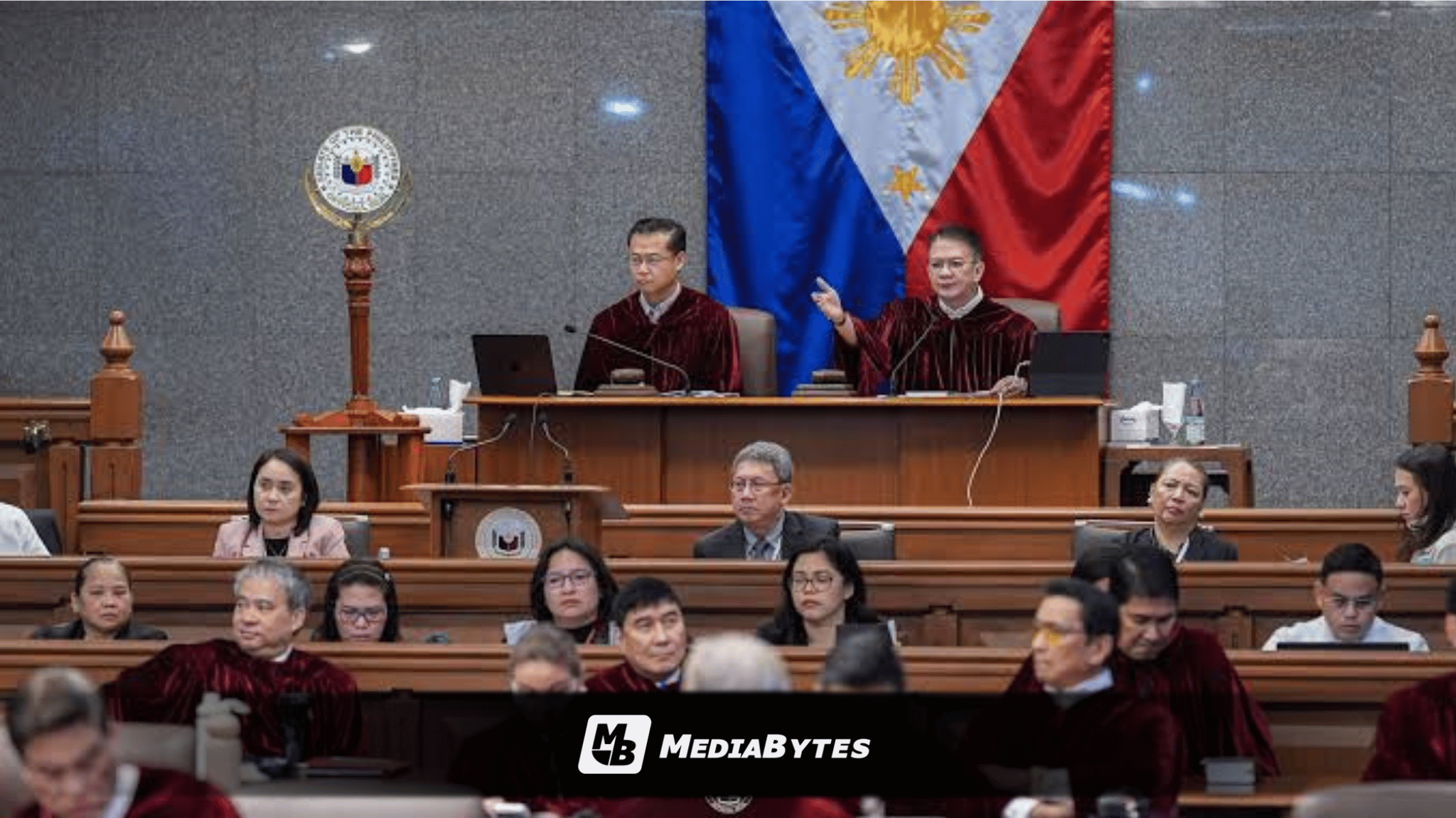
MANILA, Philippines — The Supreme Court has junked three separate petitions challenging the constitutionality of a September 23 Senate Impeachment Tribunal ruling that altered the required vote threshold to convict an impeached official.
In a press briefer released following a full-court session on Wednesday, September 30, the High Tribunal’s Office of the Spokesperson stated that the cases were dismissed “on procedural grounds including lack of standing and prematurity.” No further details were provided regarding the decision.
The dismissed petitions were filed individually by former Executive Secretary Vic Rodriguez, Berteni Cataluna Causing, and Atty. Ernesto Francisco Jr. All three petitioners requested the High Court to mandate a return to the constitutional standard requiring a two-thirds vote of the entire 24-member Senate.
Under Article XI, Section 3(6) of the 1987 Philippine Constitution:
”The Senate shall have the sole power to try and decide all cases of impeachment. When sitting for that purpose, the Senators shall be on oath or affirmation. When the President of the Philippines is on trial, the Chief Justice of the Supreme Court shall preside, but shall not vote. No person shall be convicted without the concurrence of two-thirds of all the Members of the Senate.”
In its September 23 decision, the Senate, functioning as an Impeachment Tribunal, voted to reconsider and lower the fixed requirement of 16 votes.
In his filing, Francisco contended that the tribunal’s move went beyond simple interpretation and essentially amounted to an illegal revision of the fundamental law.
He argued that the tribunal acted with grave abuse of discretion by altering the standard through a simple procedural vote and designating it as “the new controlling ruling of the court” for calculating the two-thirds requirement.
“Such action constitutes a capricious and arbitrary departure from the plain language of the 1987 Philippine Constitution, correctible through the Honorable Court’s power of judicial review,” Francisco stressed.
Francisco added that a lawmaker maintains their status regardless of physical attendance, stating:
“A senator remains a senator until his or her office is constitutionally vacated. In this regard, none of the circumstances enumerated in the Sept. 23, 2026 ‘ruling’ of the public respondent Senate Impeachment Court could be equated to a vacancy.”
He further noted that “a detained senator, a senator on medical leave, or a senator temporarily absent remains a constitutional member of the Senate. Membership pertains to constitutional status, not actual participation.”
Similarly, Rodriguez petitioned the court to void the September 23 ruling “insofar as it reduces or permits the reduction of the constitutional denominator by excluding incumbent Senators merely because they are absent, nonparticipating, unable to participate, beyond the coercive processes of the Senate, or otherwise deemed similarly situated.”
Rodriguez urged the Supreme Court to restore a July 6 ruling that acknowledged a 16-vote minimum based on a full 24-member chamber.
“The Senate, sitting as an impeachment tribunal, has effectively altered the operative meaning of Article XI, Section 3(6) without employing any of the methods by which the Constitution itself may be amended or revised under Article XVII,” Rodriguez warned.
“The challenged ruling potentially establishes a principle under which the constitutional voting requirement in impeachment may be altered depending upon the number of Senators whom the Tribunal determines to be capable of participating. The consequence would extend beyond the present impeachment proceeding. It would establish a mechanism whereby an express constitutional voting requirement could be modified by a ruling of the very body whose powers are being regulated by that constitutional provision.”
Meanwhile, Causing maintained that absent, detained, or hiding lawmakers should still count toward the total denominator. His petition sought an order preventing the tribunal from holding a final vote on Vice President Sara Duterte’s conviction while legal challenges remained pending.
He also petitioned the court to compel Senators Jinggoy Estrada, Rodante Marcoleta, and Ronald “Bato” dela Rosa to attend the proceedings, asking that the Senate take all necessary measures to ensure their presence.